

Cluster Lashes: Types, Bases, Curls and How to Buy Them
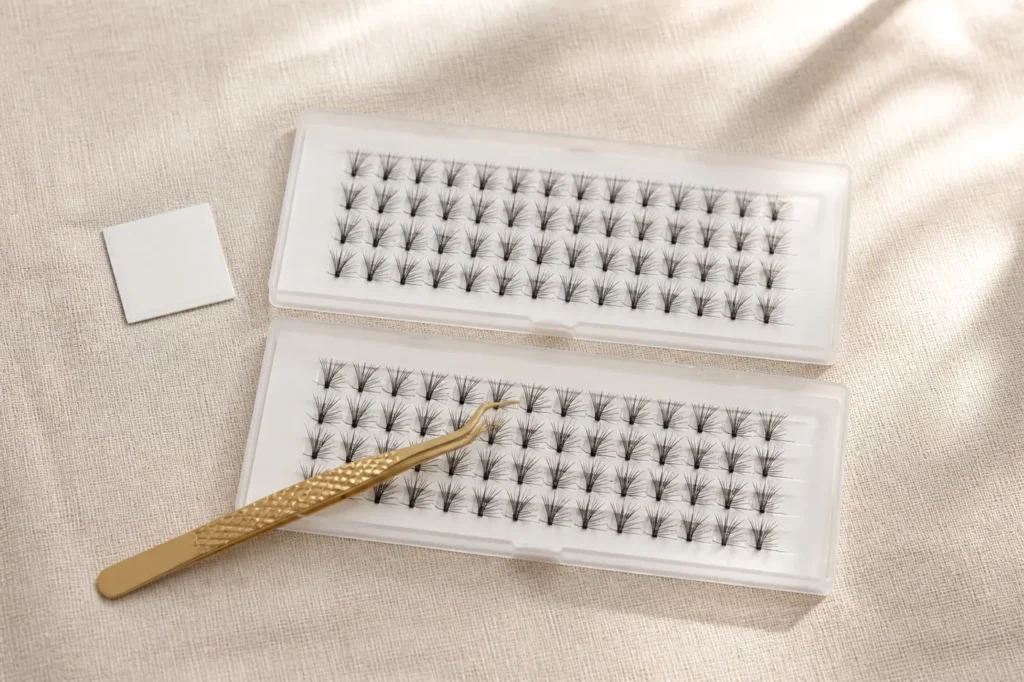
Cluster lashes reached professional supply catalogues by way of the at-home market, and that origin still shapes how they should be evaluated. A cluster is a small pre-formed fan of lash fibres bonded together at a single base, sold in trays or boxes, and used either as a fast salon service or as a self-application product paired with a bond and seal system. For a buyer, the useful question is not whether clusters sell — they clearly do — but which construction, fibre and packaging format will hold up in your market.
This guide covers what separates a well-made cluster from a cheap one: base construction, fan type, curl and length consistency, fibre thickness, and packaging. It closes with a nine-point checklist to run before you commit to a wholesale order.
What Are Cluster Lashes?
A cluster lash is three or more individual lash fibres joined at one base and sold pre-assembled, rather than fanned by the technician during the appointment. That single design decision is what makes clusters fast to apply and what makes them a different product category from the alternatives buyers often confuse them with. Strip lashes are a connected band that sits on the lid line as a consumer cosmetic. Individual extensions are single fibres grafted one to one to a natural lash. Cluster lashes sit between the two: they carry the fan structure of a volume set but arrive ready to place.
The category also travels under several names. Suppliers list the same family as lash clusters, eyelash clusters, segment lashes, or spike lashes, and the label usually signals fan count and silhouette rather than a different product. When you compare quotations from several factories, confirm that the item names describe the same construction — otherwise you are comparing a fan against a single fibre. If you are still mapping the wider category, our breakdown of the different types of lash extensions for buyers sets clusters against classic, volume and YY constructions, and the YY lashes explained guide covers the braided constructions that are frequently listed beside them.

Base Construction: The Detail Buyers Overlook
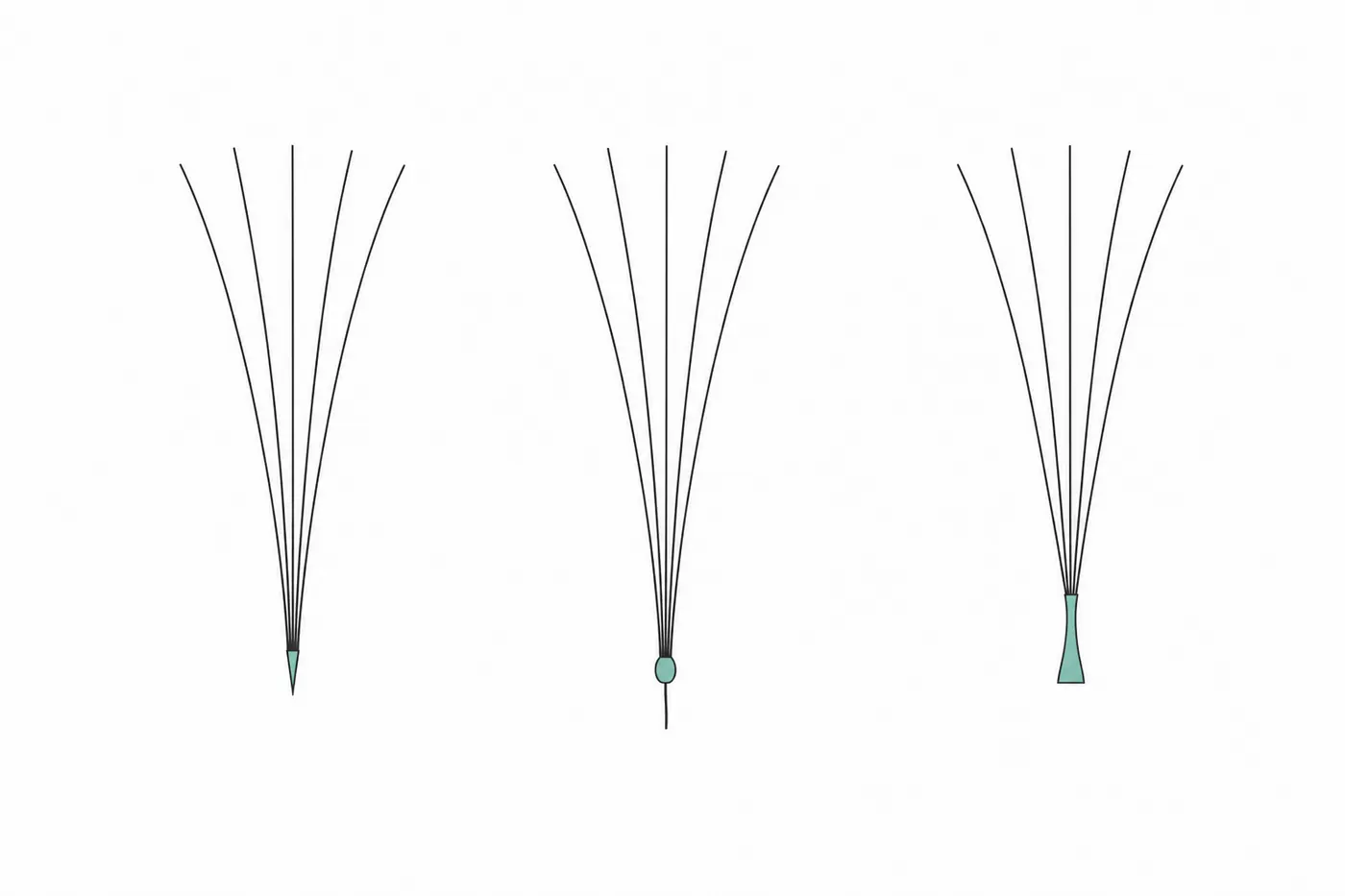
The base is where a cluster is made or lost. Three constructions dominate supplier catalogues, and each behaves differently on the natural lash. A tapered point base bonds the fibres into a single sharp tip — the most efficient fit, because the contact area is small and the fan sits flush. A loose root base leaves a short free root below the bond, which adds flexibility and lets the fan move with the natural lash. A spire or tower tip base raises a narrow bonded tip above the join before the fibres flare, which holds a tighter base width and reads as a denser fan from the front.
What you are checking, whichever base you buy, is consistency: the bond should be solid and even along its full width, with no strands splaying away from the point, no excess adhesive bulging beyond the base, and no variation in base width from one row to the next. A tray with inconsistent bases forces the technician to sort clusters mid-appointment, which cancels out the time the product was supposed to save. Ask for a sample tray and inspect a full row rather than the first three clusters.
Spike Clusters, Classic Clusters and Promade Fans
Fan count is the number of fibres bonded into each cluster and is written as a D number: 3D to 5D for lighter, natural-looking clusters, 8D and above where density is the selling point. Beyond the count, three silhouettes matter commercially. Classic clusters bond fibres of even length into a uniform fan, producing a clean, predictable line. Spike clusters stagger the fibre lengths so the silhouette tapers to points, which is why they are the format behind most spiky, wispy set names. Promade clusters are machine-arranged fans supplied in high-count trays, built for speed and volume rather than for hand-fanned control.
Buyers often stock two of the three and let the third be a special order. The decision usually comes down to who applies them: a salon working toward volume sets will consume promade clusters quickly, while a reseller targeting the DIY market usually sells spike and classic clusters in smaller, retail-ready boxes. Our comparison of premade versus promade lash fans breaks down how the two supply routes differ, and camellia lashes versus easy fan lashes covers the textured fan styles that sit closest to clusters in customers’ minds.
Curl, Length and Fibre Choices
Curl and length tolerance is tighter for cluster lashes than for individually grafted lashes, because the cluster is applied as a unit. A single fibre with an off curl inside a fan is visible immediately, and it cannot be corrected without removing the whole cluster. Specify the curl code you need — C, CC, D and L curls cover most demand — and confirm that every cluster in the box carries that curl rather than an average of it. Length consistency matters in the same way: mixed-length trays are a legitimate product, but only when the lengths are labelled row by row.
Fibre choice is narrower than the marketing suggests. Clusters are built from synthetic PBT fibre with a matte finish; the variable that changes performance is fibre thickness, usually expressed in millimetres per fibre. Thinner fibre allows a higher fan count at an acceptable weight, which is why 0.05 mm and 0.07 mm fibres dominate cluster trays, while heavier fibre is used for lighter, stiffer clusters. Thickness also drives cost, so a quotation that looks low may simply be built on heavier fibre with a lower count. Our guide to spotting low-quality lashes lists the visible signals to check on arrival.
How Clusters Are Packaged and Sold
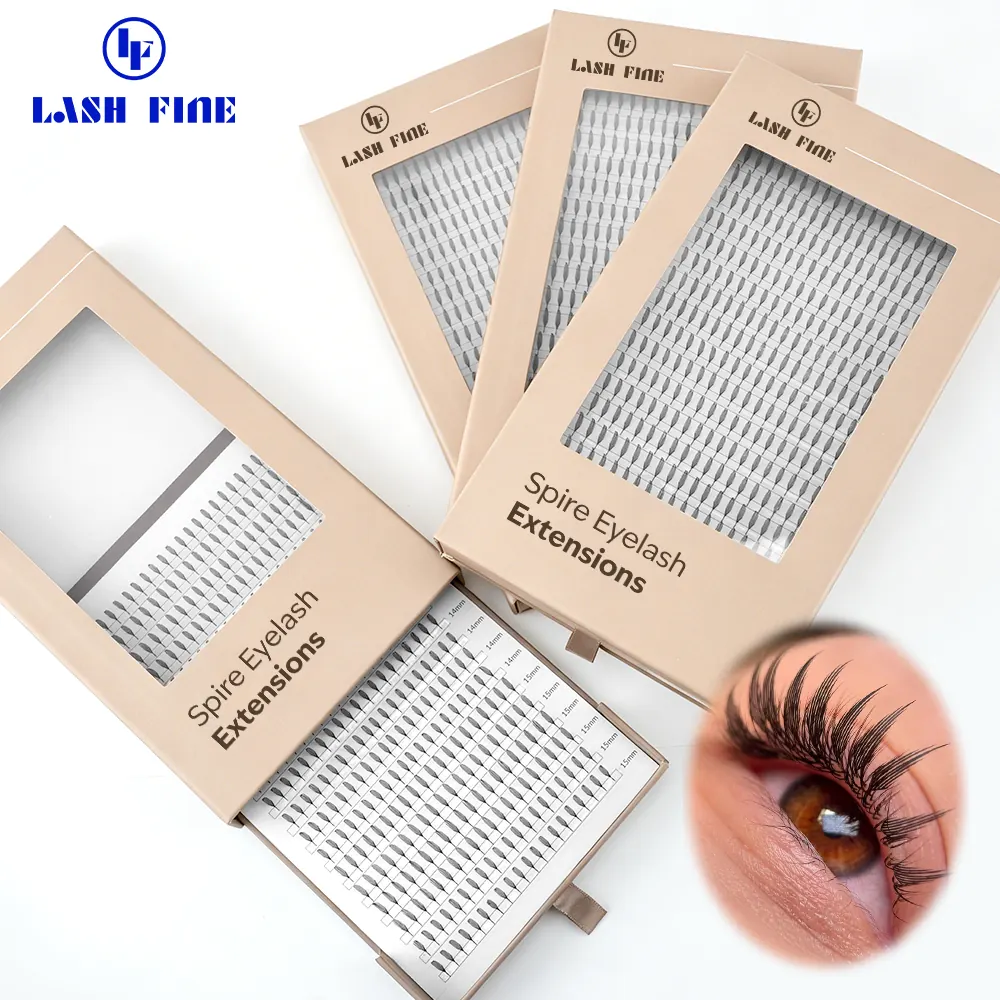
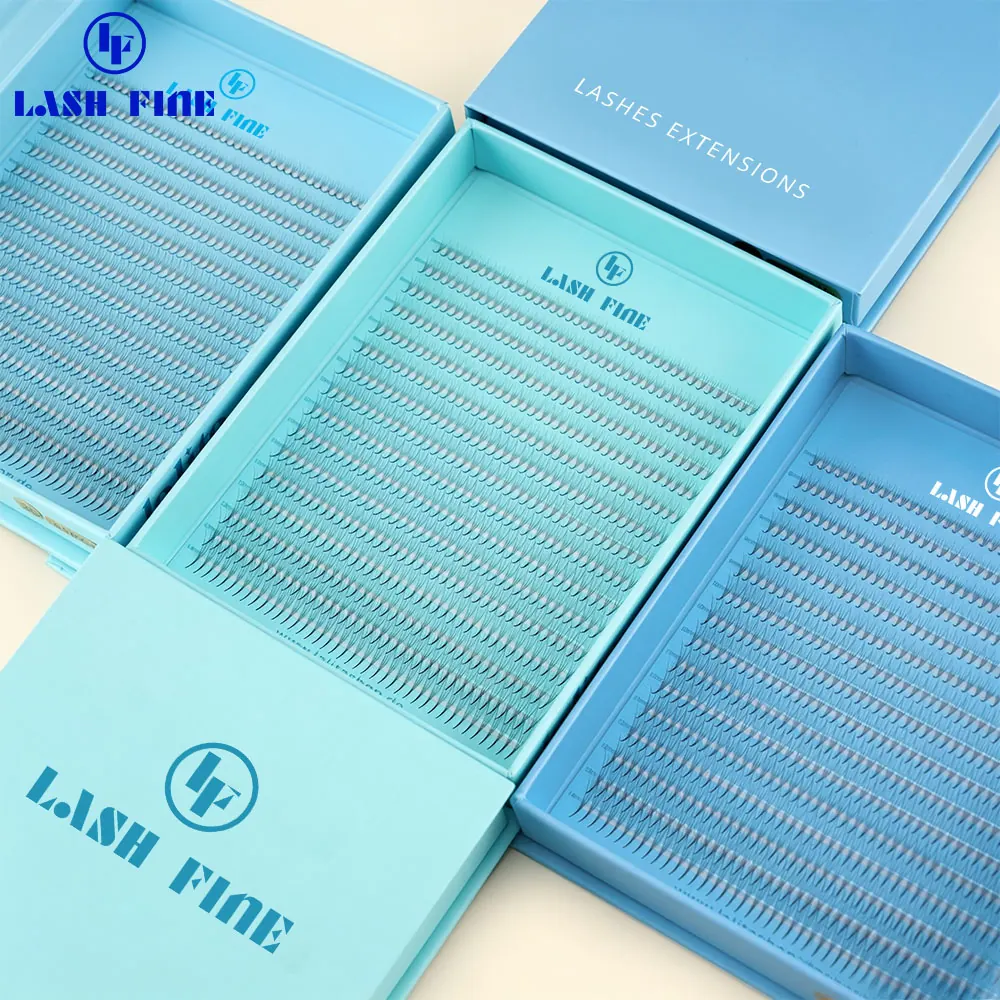
Clusters are supplied in three formats, and the format changes both the unit cost and the channel the product suits. Trays hold rows of clusters on an adhesive strip, the format technicians buy most often. Window pull-out boxes hold the same fans with length labels printed beside each row, which makes them easier to sell to less experienced buyers. Retail-style segment boxes package clusters in smaller counts with a kit presentation, aimed at the DIY customer rather than the salon.
Before you order, confirm what is actually inside the count you are quoted. Rows and clusters per row vary by factory and by fan count, so a quotation written only as “one box” tells you nothing about unit economics. Ask for the row count, the clusters per row, and the labelled lengths, then price the order per cluster rather than per box. It is also worth testing how the fans release from the adhesive strip: a strip that grips too hard tears fans as they are lifted, which shows up as damaged product complaints rather than as a manufacturing defect.
DIY Application vs Professional Use
The same cluster product serves two very different buyers. In the salon, clusters are applied with adhesive in the same way as any other extension, chosen because a full set takes a fraction of the time an individually grafted volume set requires. For the DIY buyer, clusters are applied with a bond and seal system: a bonding agent along the natural lash, the cluster pressed into place, then a sealing coat to lock the base. If your market is the DIY channel, the product you ship is only half the offer — the adhesive system decides whether customers reorder.
Retention expectations should be set honestly in your product copy. Clusters applied with bond and seal are designed for a shorter wear cycle than individually grafted extensions, and positioning them as equivalent invites returns. Our bond and seal product guide covers the adhesive side of a DIY kit, and the easy fanning technique guide is useful background for customers who want to fan their own clusters.
A Wholesale Buyer’s Checklist
Run these checks before committing to a cluster lash order, and repeat them on each new production batch rather than once per supplier relationship.
- Request a sample tray and inspect a full row, not the first three clusters.
- Confirm the base type in writing — tapered, loose root or spire — and the base width tolerance.
- Check curl consistency across the tray against one specified curl code.
- Confirm the labelled lengths, if the tray is sold as a mixed-length product.
- Test that fans lift cleanly off the adhesive strip without tearing.
- Ask for the row count and clusters per row, then price the order per cluster.
- Confirm the packaging format and whether private label printing is available.
- Verify the bond: no splayed strands, no excess adhesive beyond the base.
- Order one tray per specification before scaling to a full production run.
If you also stock the tools that go with clusters, our lash tweezers buyer’s guide covers tip shapes and alignment checks, which is the other half of making a cluster set fast to apply.
Mistakes That Cost Salons and Resellers Money
The most expensive mistake is buying on fan count alone. A 10D cluster built on an inconsistent base will slow an appointment down more than a well-made 6D cluster, because the technician has to sort and reject fans as they work. The second is treating fibre thickness as a detail: two factories can quote the same fan count at very different prices by changing the fibre weight, and the difference shows up in how the set looks on the eye rather than on the invoice.
A third mistake is shipping one product to two channels. DIY buyers need small counts, clear instructions and retail packaging; salon buyers need high-count trays and predictable base widths. Selling one format to both leaves margin on the table at one end and generates complaints at the other. Finally, storage is worth a line in your own handling notes: clusters held in humid conditions can lift from their strip and lose their fan shape before they are ever applied.
Choosing a Cluster Lash Supplier
For a buyer, a cluster lash supplier is really a consistency supplier. Price matters, but the specification sheet matters more: base type, fibre thickness, curl code, lengths and packaging format, all recorded so that the second order matches the first. That is the difference between a product line that compounds and one that has to be re-sourced every season.
If you are building a cluster range, start with the premade spike lashes and premade lash fan trays specifications to compare base construction, or review the wholesale premade lash fans range if your clients work toward volume sets. Salons building a density offer alongside clusters can pair them with volume lashes, and for a wider product review, the volume lash master guide covers the fan-building side of the craft.


 English
  German
  French
  Spanish
  Romanian
  Portuguese
  Dutch
Dutch  Italian
  Swedish
  Polish