

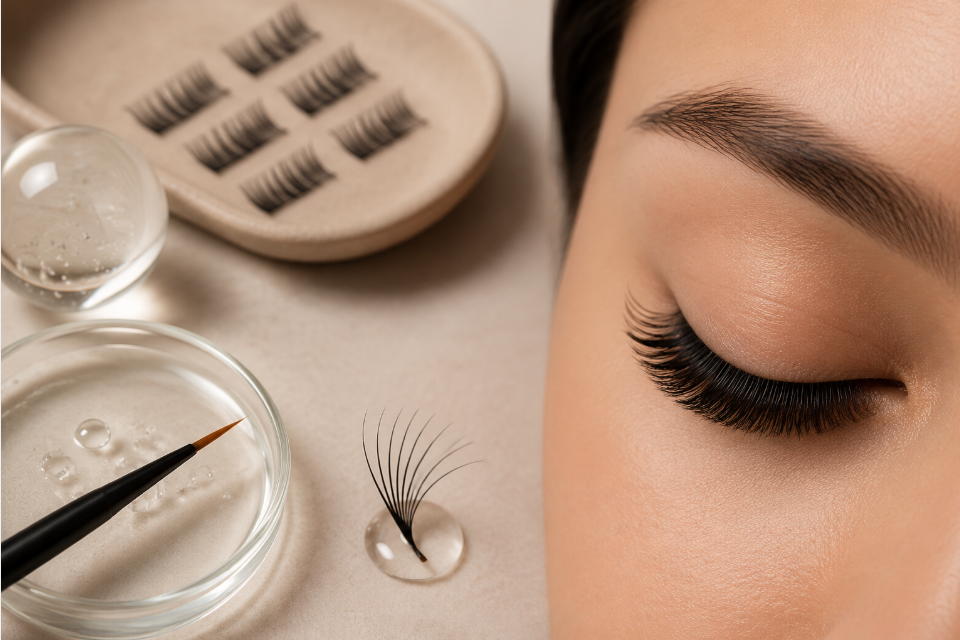
Lash porosity is the degree to which a lash extension fiber surface can interact with adhesive at a microscopic level. A smoother, more sealed fiber gives adhesive fewer anchor points, while a more textured surface can create more opportunities for bonding and retention.
If you have already changed adhesives, adjusted humidity, and refined your wrapping technique, but retention is still inconsistent, the problem may not be your glue alone. The surface of the lash extension fiber can affect how well adhesive grips, how much the extension slides during placement, and how stable the bond becomes after curing. That is why lash porosity is attracting more attention in the lash community in 2026.
For brands and lash professionals sourcing private-label products, this topic matters because material consistency affects performance, not just packaging. Lashfine, which positions itself as a lash business partner with years of industry experience, develops eyelash extension products in response to expert opinions and customer requirements—exactly the kind of product-development approach that makes fiber behavior more relevant to retention discussions.
What Is Lash Porosity?
Lash porosity refers to how readily an extension fiber surface interacts with adhesive. It is not the same thing as natural lash health or hair porosity, but the comparison is useful because both involve surface structure and absorption behavior.
On a standard smooth fiber, adhesive mostly sits on the outside. On a more textured or porous fiber, the surface can create additional micro-contact points, which may improve grip and help the extension stay positioned more consistently during application.
Applied from Hair Porosity
Many beauty professionals already understand porosity through hair science. In low-porosity hair, cuticles lie flatter and more tightly sealed, so products tend to sit on the surface longer. In higher-porosity hair, the cuticle structure is more open, which allows moisture and treatments to penetrate more easily.
That framework helps explain why a sealed lash fiber can be harder for adhesive to grip. If the fiber surface is too smooth, the bond depends on a smaller number of friction points. If the surface is more textured, there can be more surface interaction for the adhesive to hold onto.
For readers looking for a scientific basis for the hair analogy, the cuticle-structure discussion is standard in cosmetic fiber science and trichology references, including educational material from dermatology and hair-science sources such as Dr. Serkan Aygin’s hair-porosity explanations. In lash work, the point is not that extension fibers behave exactly like scalp hair, but that surface structure changes product interaction.
Why the Industry Is Talking About It in 2026
The retention conversation in lash work has historically centered on adhesive chemistry: faster setting, stronger hold, and better performance in different room conditions. Industry discussions around porous fiber suggest a broader shift toward the full bonding system, not just the glue.
That said, the phrase “chemical ceiling” should be treated carefully unless it is backed by a specific material or product test. As a general industry claim, it means that there may be diminishing returns from adhesive-only improvements if the fiber surface remains too smooth for optimal bonding. This is why material engineering is now being discussed alongside adhesive performance.
In practice, the claim is not that adhesive innovation has stopped, but that retention may be increasingly constrained by how the fiber surface accepts and holds the adhesive. For a publishable, fully traceable version of this argument, the strongest support would come from:
- a named adhesive manufacturer’s technical bulletin describing bond limits under specified humidity and temperature conditions
- a materials-science explanation of surface energy, roughness, or coating behavior
- side-by-side retention or pull-performance testing against a smooth-fiber control
How Lash Porosity Affects Adhesive Bonding
The mechanism is easier to follow when broken into separate steps.
| Mechanism | Smooth fiber | Textured or porous fiber | Why it matters |
|---|---|---|---|
| Adhesive contact area | Adhesive mainly sits on the outer surface | Micro-ridges or grooves can increase contact points | More contact area can support a more secure bond |
| Sliding behavior | The extension may shift more easily before the adhesive sets | Micro-friction can help the extension stay in place | Better placement stability can improve application control |
| Curing consistency | Adhesive may pool or distribute unevenly | Adhesive may spread more evenly across the surface | A more even bond can support cleaner curing and better retention |
What Makes a Fiber Surface “Porous” in Practice?
In professional lash materials, porosity does not always mean full internal absorption. It can also refer to a controlled textured surface that improves adhesion through surface-level bonding rather than deep penetration. That distinction matters.
A lash fiber does not need to behave like an absorbent sponge to be useful for retention. A measurable surface texture, if designed consistently, may already be enough to change how adhesive performs.
Brand and Material Context: What Can Be Verified Right Now
The source content refers to Cashmere Silk as an advanced textured-surface material, but it does not include verifiable product specifications, lab methods, or a linkable company source. Without verified source material, the safest way to state the claim is to keep it general: Cashmere Silk is presented as a lash extension material with an engineered textured surface intended to support adhesive grip.
This is also where brand credibility matters. Lashfine emphasizes private label support, customer care, and product development informed by expert opinions and customer requirements, which aligns with the kind of documentation buyers should request before accepting any textured-fiber claim.
To make this claim fully traceable in a publishable version, the article would need details such as:
- a measurable surface specification, such as roughness or coating behavior
- test conditions, such as humidity, temperature, or adhesive type
- comparison results against a smooth-fiber control
- a named manufacturer or lab source with a product page or technical sheet
If a brand or testing partner supplies that information, it should be anchored with a specific product page, technical data sheet, or material-testing note rather than generic praise language. That is the most reliable way to support the claim for AI extraction and reader trust.
What to Watch for When Evaluating Porous Fiber Claims
Because the topic is still emerging, lash artists and trainers should ask for practical evidence rather than vague marketing language. Useful proof would include:
- side-by-side retention testing against a smooth fiber
- a defined adhesive type used in the test
- application conditions such as humidity and temperature
- repeatable results from a named material source or training brand
When reviewing a product claim, it also helps to ask whether the test was performed on real models, mannequin strips, or in controlled lab conditions. Those details affect how transferable the result is to studio work.
Recognized Lash Ecosystem Context
Lash artists often rely on training organizations and standards-based education to separate marketing claims from operational reality. In that ecosystem, product claims are more useful when they can be compared against consistent application frameworks used by recognized lash educators and training brands.
Examples of the kinds of anchors that make an article more verifiable include:
- named lash training organizations
- manufacturer technical sheets
- standard room-condition guidance from adhesive brands
- material-science terminology such as surface texture, surface energy, and curing behavior
That does not prove a product is better on its own, but it gives the industry a shared language for evaluating whether a fiber surface change is likely to matter in practice.
Limitations of Porous Lash Fiber
Porous or textured fiber is not a universal fix. Adhesive performance still depends on the natural lash condition, attachment point, humidity, adhesive age, isolation quality, and placement technique. A better fiber surface can support retention, but it cannot replace sound application fundamentals.
It is also important not to overstate the mechanism. A more textured surface may improve bonding opportunities, but the exact result will depend on the fiber design and the adhesive system used with it.
In other words, porous fiber is best understood as one part of a larger retention system. It can improve the odds of a stable bond, but it does not remove the need for correct adhesive handling, clean prep, and precise application.
FAQ
Does lash porosity replace good adhesive technique?
No. It can support retention, but it does not replace proper adhesive control, isolation, wrapping, or environmental management.
Is porous fiber always better than smooth fiber?
Not automatically. The benefit depends on how the surface is engineered and whether it works well with the adhesive and application method being used.
What evidence should I look for before trusting a porous-fiber claim?
Look for measurable product details, a named brand or lab source, comparison testing against a smooth-fiber control, and clear test conditions such as humidity, temperature, and adhesive type.
What is the most important decision criterion for artists?
Choose fiber based on verified performance, consistency, and how well it integrates with your adhesive system and technique—not on marketing language alone.
Is the hair-porosity analogy scientifically exact?
No. It is a useful reference point, but lash extensions and natural hair are not identical materials. The comparison is meant to explain how surface structure can affect product interaction, not to claim the two behave the same way.

