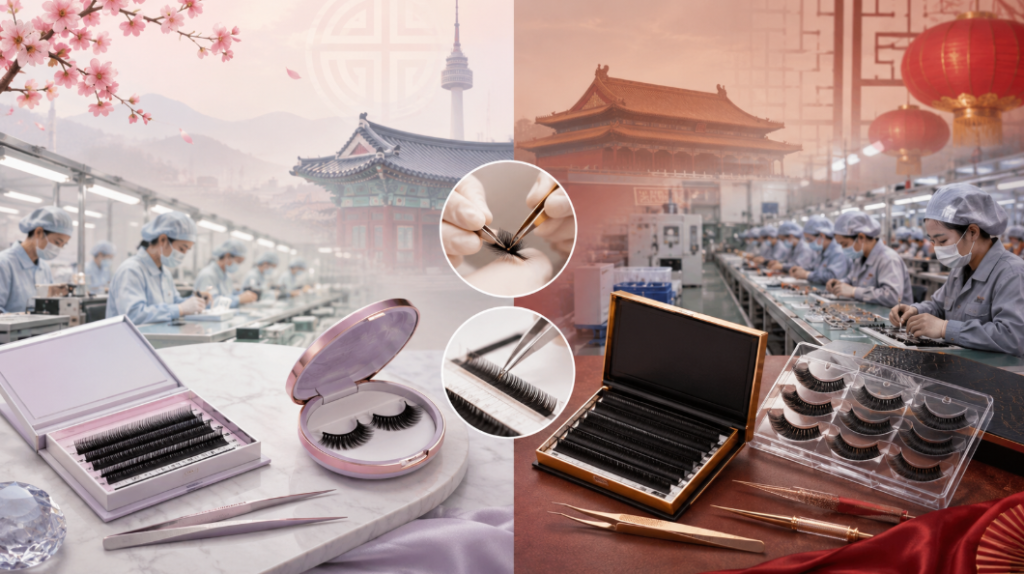
If you are comparing lash manufacturing countries, Korea is usually the better fit for premium positioning and trend-led product development, while China is usually the better fit for cost efficiency, scale, and flexible private-label sourcing.
For buyers deciding between Korea vs China for lash manufacturing, the best choice depends on brand positioning, budget, customization needs, and launch volume. If you are building a premium line, Korea often supports that image better. If you need accessible pricing and scalable bulk supply, China is often the more practical option.
Overview of lash manufacturing in Korea and China
Korea and China are two of the most relevant lash manufacturing countries in Asia. Both serve beauty businesses that want bulk supply, private labeling, and product customization, but they tend to fit different business models.
- Korea is often associated with premium lashes, advanced production methods, and trend-driven product development. Higher raw material sourcing costs and labor costs often place Korean-made lashes in a higher price tier.
- China is often associated with affordable bulk production, wide supplier availability, and flexible private-label manufacturing. Buyers often choose China when they need to balance unit cost, volume, and customization.
In short, Korea usually signals premium branding and innovation, while China usually signals scale, pricing flexibility, and broad sourcing options.
Similarities between lash manufacturing in Korea and China
Korean and Chinese lash manufacturers share several core strengths in wholesale production:
- Bulk supply capability: Both countries support wholesale orders for brands, salons, and distributors.
- Private labeling: Both markets commonly serve buyers who need branded packaging and custom presentation.
- Multiple style options: Suppliers in both countries can offer different lash styles, curls, thicknesses, and lengths.
- Sample-based buying: Buyers typically review samples, confirm specifications, and approve packaging before mass production.
- Commercial flexibility: Both countries can support different launch strategies, from test orders to larger replenishment runs.
These similarities mean both markets can work for buyers who need variety and sourcing flexibility.
Differences between lash manufacturing in Korea and China
The main differences come down to product positioning, pricing, and the type of buyer each market tends to serve.
Product focus
- Korea: Often linked with premium fashion lashes, innovative styles, and products designed to support a higher-end brand image.
- China: Often linked with practical wholesale lash production, cost-conscious sourcing, and broad private-label options.
If your brand competes on presentation and trend leadership, Korea may be the stronger fit. If your priority is accessible sourcing and scalable volume, China may be the better fit.
Innovation versus production scale
Korean suppliers are commonly associated with innovation, advanced techniques, and trend sensitivity. Chinese suppliers are more often associated with production scale, sourcing flexibility, and a wider range of factory options.
This is not a question of better or worse. It is a question of what your business needs most: brand differentiation or operational efficiency.
Pricing and sourcing structure
Korean lashes usually carry higher price points because of higher raw material sourcing costs and labor costs. China is generally more affordable and better suited to lower unit costs.
For buyers, the commercial difference is straightforward:
- Korea: higher unit cost, stronger premium positioning, better fit for brands that can absorb higher landed costs.
- China: lower unit cost, better margin control, and more room for competitive pricing or larger test orders.
A lower quote does not always mean a better deal. Buyers should compare pricing in context, including packaging, logo printing, sample costs, and order quantity requirements.
Private labeling and customization
China is often the more practical option for buyers who need private labeling, packaging flexibility, and scalable customization. Korea can also support custom work, but it is more often associated with premium, brand-led collections.
When comparing suppliers, ask:
- Can the factory customize packaging, tray design, logo printing, and inserts?
- Does it support OEM or ODM development?
- Are samples available before mass production?
- Do order quantity requirements change for custom items?
How to choose between Korea and China
Use these criteria to make a practical sourcing decision:
- Choose Korea if you want: premium market positioning, trend-led lash styles, and a supplier profile that fits established beauty brands.
- Choose China if you want: lower pricing, broader sourcing options, private-label support, and a stronger starting point for volume-driven or budget-sensitive launches.
- Compare product specs carefully: request curl, thickness, length, tray count, and packaging details before ordering.
- Check sample policy and order quantities: these two factors often determine whether a supplier fits your launch plan.
- Review quality control expectations: ask how the factory checks consistency, packaging accuracy, and material stability.
A useful rule is simple: if your business depends on premium presentation, Korea may justify the higher landed cost. If your business depends on margin protection, scale, and flexible sourcing, China is usually the more practical choice.
Market positioning, timelines, and order planning
A strong sourcing decision should consider more than product appearance. It should also match your launch schedule and commercial model.
- Pricing tiers: Korea is generally better aligned with higher-priced product tiers, while China is generally better aligned with accessible wholesale tiers.
- Order quantity considerations: The source does not provide fixed minimums, so buyers should confirm order quantities by style and packaging format.
- Production timelines: Ask for separate estimates for sampling, custom design approval, and bulk production.
- Sales channel fit: Premium retail and salon channels may justify a higher-cost supplier, while marketplaces and test launches may benefit more from lower entry pricing.
For lash brands, the key question is not only where the lashes are made, but whether the supplier structure supports your launch plan, packaging needs, and target retail tier.
Buyer questions to ask before ordering
Ask both suppliers the same questions before you place an order:
- What is the minimum order quantity for each lash style?
- Do you offer OEM or ODM services?
- Are samples available, and are they free or paid?
- What is your typical production timeline for bulk orders?
- What quality control steps do you use before shipment?
- Can you support custom packaging, branding, and specification changes?
- Which materials do you use for lashes, trays, adhesives, or packaging components?
- Can you provide documentation for quality, material sourcing, or compliance if needed?
- Do you have any third-party inspection records you can share?
- What is the difference in order quantities and timelines between stock products and custom products?
Look for specific answers. A strong supplier should explain what can be customized, what cannot, and how long each step takes.
FAQ
What is the minimum order quantity for lash manufacturing in Korea or China?
Minimum order quantity varies by supplier, style, and packaging complexity. The source does not provide a fixed number, so buyers should request MOQ details directly for each product line.
Do Korea and China suppliers offer OEM or ODM options?
Yes, both markets can support private-label sourcing, but the level of customization depends on the factory. Buyers should confirm whether the supplier can handle custom styles, packaging, and branding or only existing templates.
Can I request samples before placing a bulk order?
Yes, sample review is a standard part of supplier evaluation. The source does not define a universal sample policy, so buyers should confirm whether samples are free, paid, or credited against the first bulk order.
What should I compare besides price?
Compare order quantities, sample policy, customization range, packaging options, production timelines, quality control, and brand fit. Price alone is not enough to judge a lash supplier.
Which country is better for a new lash brand?
Korea is usually better for premium positioning and innovation-led branding. China is usually better for lower entry cost, private labeling, and flexible bulk sourcing.