


Search this question in the US and you get a wall of confident answers: yes, completely safe, no risk of injury or discomfort, most medical professionals consider it safe. Six of the top nine results say some version of that. One pregnancy clinic says the opposite – avoid it for now, because there is not enough research to say either way. One forum thread sits in between.
Almost none of them cites anything. The confident ones are salon blogs, supplier blogs and an Instagram reel; the cautious one is a clinic; the studies that would settle it do not appear on the page at all, because for this specific question they largely do not exist.
That is the honest starting point, and it changes what an article on this topic can usefully do. It cannot certify safety. It can set out what is known about the components, what changes during pregnancy that actually affects the appointment, and what a technician should say and record when the answer is genuinely unknown.
What the Evidence Covers, and What It Doesn’t
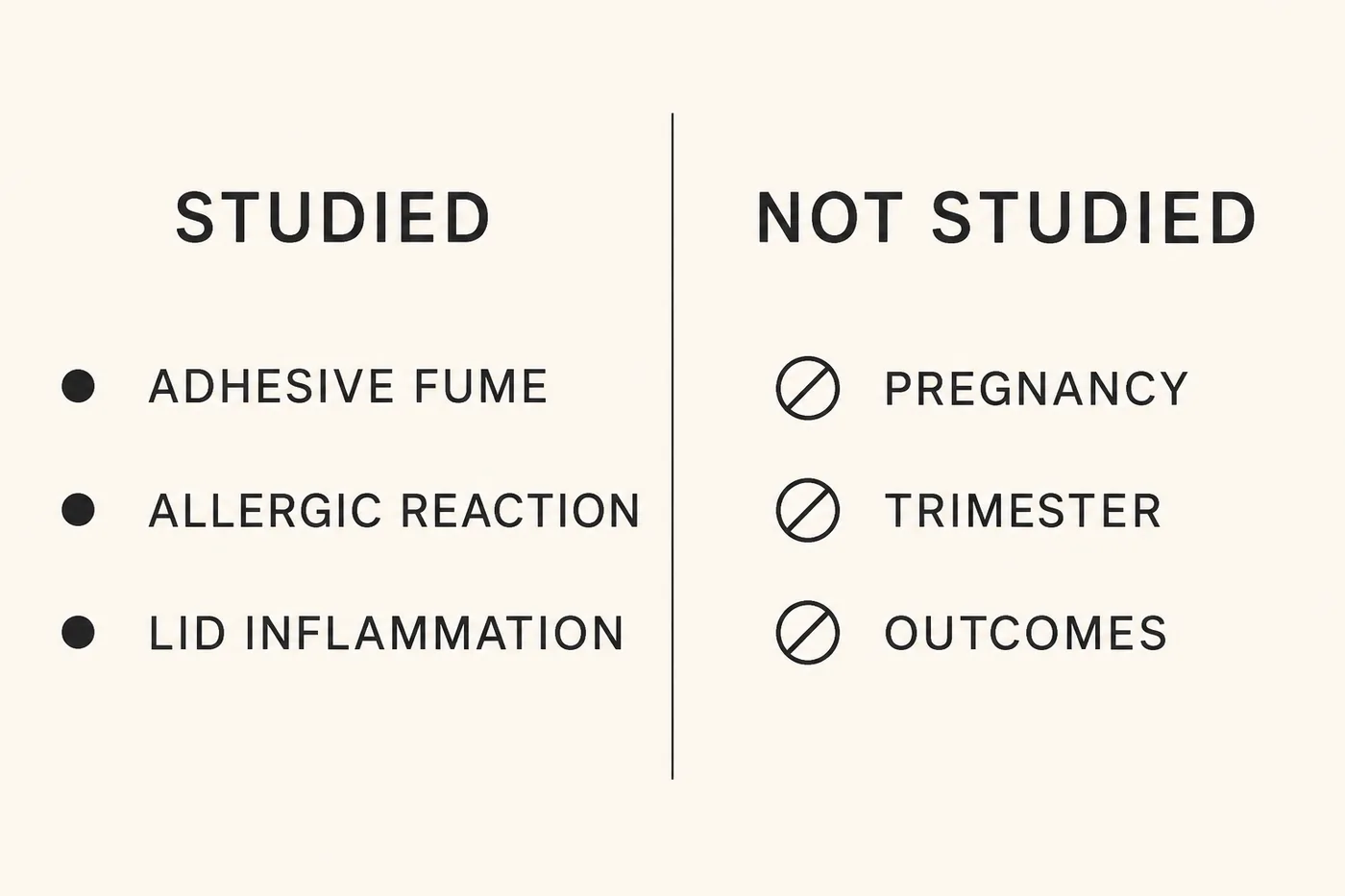
There is real literature on lash extension complications in general. Work on ocular disorders from extensions documented keratoconjunctivitis and allergic blepharitis as recognised outcomes and noted formaldehyde release from lash adhesives (PMID 22134404). A later review of eyelid cosmetic enhancements reported allergic blepharitis as the most common complication, accounting for the majority of blepharitis cases in the population studied (PMC6592309).
None of that literature is about pregnancy. It describes reactions in the general population of wearers. Extrapolating it to pregnancy is an inference, not a finding – and it is exactly the inference the confident pages are making without saying so.
In the sources consulted for this piece, no study was found that examines lash extension outcomes specifically in pregnant clients. That absence cuts both ways. It is not evidence of harm, and it is not evidence of safety. A technician who says “it’s fine, I’ve done it for eight years” is reporting an anecdote, which is not the same category of information as a study, however long the eight years were.
Why “Completely Safe” Is Not Yours to Say
A technician’s scope of practice does not include certifying the safety of a chemical exposure during pregnancy. That is not modesty; it is the boundary that keeps the conversation honest.
There is also a practical reason. If a client is later told by a clinician that she should not have had the treatment, “my lash tech said it was completely safe” is a sentence that damages the technician more than “my lash tech explained what is and isn’t known, and suggested I check with my midwife”.
The defensible position is narrow and easy to state: the components are well characterised, the pregnancy-specific evidence is not, and the decision belongs to the client with her clinician. A technician can inform that decision without making it.
What Genuinely Changes During Pregnancy
Four things change that affect the appointment, and none of them require a medical judgement.
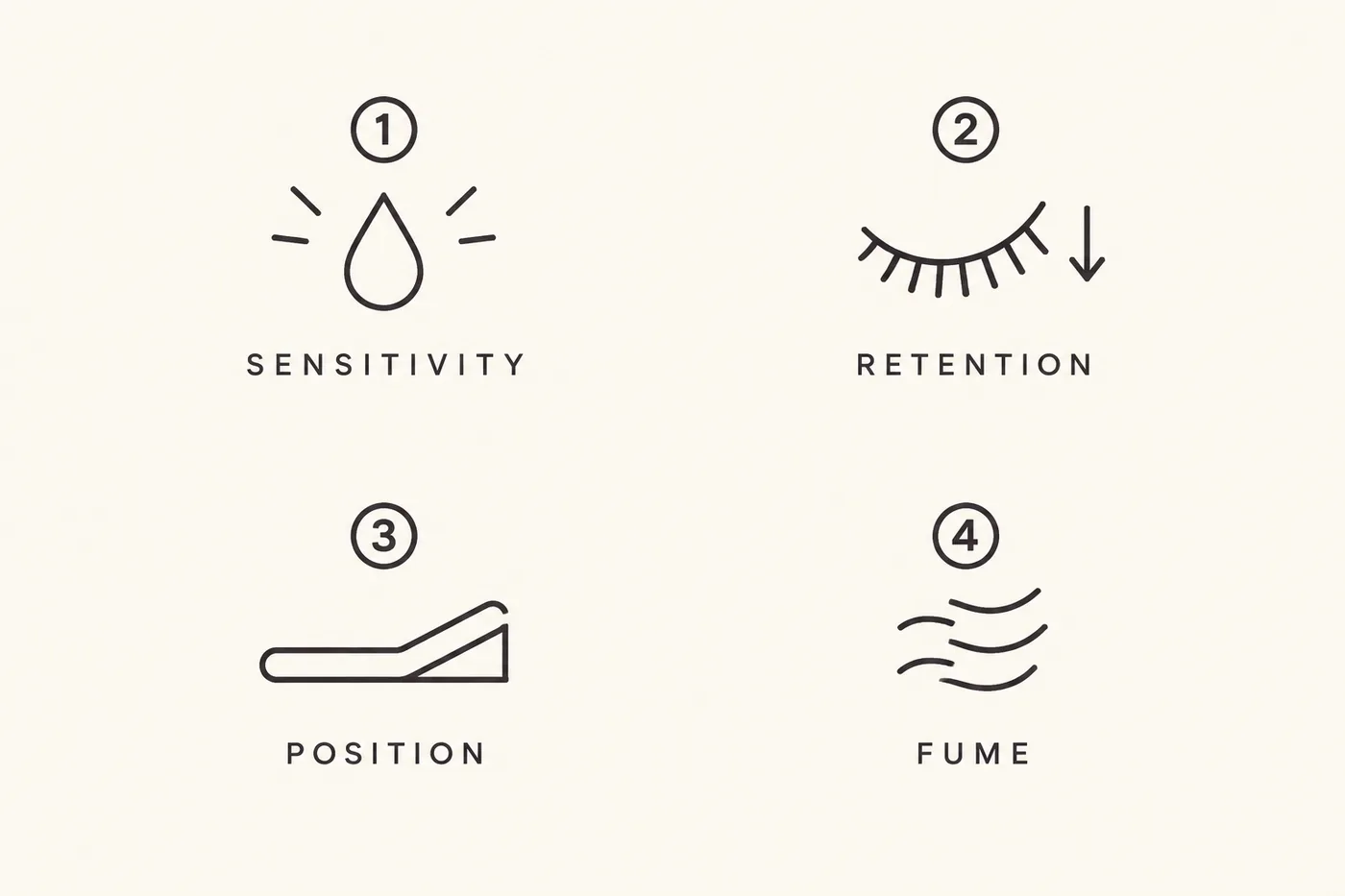
Sensitivity can shift. Hormonal changes are commonly reported to alter skin and mucous membrane reactivity, which matters because a patch test taken before pregnancy does not necessarily predict a reaction during it. A fresh patch test is a reasonable ask, and it should be documented with the date.
Retention changes, in both directions. Many clients report lashes holding better during pregnancy and shedding heavily after delivery, which is consistent with what is known about hair growth cycles rather than anything about the adhesive. Expect a different refill rhythm, and say so before the set is applied rather than after.
Lying flat for a long session becomes uncomfortable. Supine position for 90 minutes or more is poorly tolerated by some pregnant clients, particularly later on. Shorter sessions, a wedge or bolster under one hip, and a scheduled break are practical adjustments rather than clinical ones.
Fume tolerance can drop. Nausea and heightened smell sensitivity are common, and an adhesive that was tolerable at eight weeks can be intolerable at twenty. Ventilation and a lower-fume formulation are the available mitigations, and neither is a guarantee.
The Conversation, and the Record
The most useful thing a technician does here is ask, listen and write it down.
Ask directly whether the client has raised the treatment with her midwife or obstetrician, and what she was told. Not to gatekeep – to know. Some will have been told it is fine, some will have been told to avoid it, and a few will not have asked.
Say plainly what is known and what is not. The script is short: the adhesive and its fume are the parts that raise the question, the pregnancy-specific evidence is thin, and the reactions documented in general use are mostly allergic.
Record the answer, the date, the products and the batch, and the client’s decision in her own words. The consent form structure for this is set out in the guide to lash extension consent forms, and it is the document that makes the rest of this article actionable rather than theoretical.

Practical Adjustments Worth Making
None of these require a policy change, and all of them reduce the chance of a bad afternoon.
Shorten the session. A first set on a pregnant client is a poor candidate for a full volume build; a classic set in a shorter appointment is easier to tolerate and easier to abandon if she needs to stop.
Prop the position. A wedge under one hip rather than fully flat, and a break at the halfway point.
Ventilate. A small fan moving air away from the face, and adhesive applied in smaller drops more often rather than a large drop that sits fuming.
Patch test again, and date it. Previous tolerance is not current tolerance, and the daily-routine context is in lash extension aftercare.
Do not bundle extras. A lift plus a tint plus a set is three chemical exposures in one appointment; none of them is urgent.
When to Say No
There are situations where the answer is genuinely no, and they are not about pregnancy itself.
An active eye infection or lid margin flare is a stop, on the same reasoning as any other client, and the observation checklist for that is in blepharitis and lash extensions. A previous allergic reaction to an adhesive is a stop until the product question is resolved, and the management path is set out in allergia alle extension ciglia. A client who is asking the technician to guarantee the safety of her pregnancy is a stop, because that guarantee cannot be given and the appointment is really a request for reassurance that belongs elsewhere.
A clinic or clinician has advised against it: that ends the discussion. The technician is not a second opinion.
What a technician should not do is invent a blanket rule in either direction. “We don’t lash pregnant clients” and “pregnancy makes no difference” are both policies presented as facts, and neither is supported by evidence.
FAQ
Can you get lash extensions while pregnant? Many pregnant clients do, and no study was found showing harm specifically in pregnancy. Equally, no study was found establishing safety. The honest answer is that the pregnancy-specific evidence is thin, and the decision belongs to the client with her clinician.
Are lash extensions safe during pregnancy? A technician cannot certify that. The components are well characterised and reactions in general use are mostly allergic, but that is not the same as a safety finding for pregnancy.
Do pregnancy hormones affect lash retention? They are commonly reported to. Retention often improves during pregnancy and drops after delivery, which is consistent with hair growth cycle changes rather than with anything the adhesive does.
Should a patch test be redone during pregnancy? It is reasonable to. Sensitivity can change, and a test taken before pregnancy does not necessarily predict a reaction during it.
Is it safe in the first trimester? There is no evidence specific to trimesters. A technician who declines in the first trimester is making a policy choice, which is defensible if it is described as a policy rather than as a finding.
The Short Version
The internet says lash extensions are completely safe in pregnancy, and the internet has no study to point at. One clinic says avoid them, and it has no study either. What exists is general literature on adhesive reactions and a well-founded understanding of what changes during pregnancy that affects comfort, sensitivity and retention.
That is enough to run a careful appointment and not enough to issue a verdict. Say what is known, ask what her clinician said, record the answer, adjust the session, and let the decision sit where it belongs.
One disclosure: we manufacture lash extensions and adhesives, so we benefit when the treatment goes ahead. That is precisely why this piece does not tell you it is safe, and why it points at the missing evidence rather than at the reassurance our category prefers.


 English
 German
 French
 Spanish
 Romanian
 Portuguese
 Dutch
 Italian
 Swedish
 Polish