


Blepharitis is the one condition where a lash technician’s job changes completely, and the change is not the one most advice describes. The usual framing is “can you wear extensions if you have blepharitis”, and the usual answer is “yes, if it is well managed”. That answer is true and it hides the decision that actually matters, which is whether the lid is quiet today.
Because blepharitis is commonly chronic, a client can have it for years and still wear extensions for years. What cannot happen is applying a set during an active flare, and the technician is the person most likely to see the flare first – closer, in better light, and more often than any clinician.
That is the boundary this piece stays inside: what a technician can observe, what those observations mean for today’s appointment, and where the decision stops being theirs.

Why Extensions Are Associated With It At All
Blepharitis is inflammation of the lid margin – the strip of tissue the lashes grow out of. The mechanisms usually described are bacterial overgrowth along that margin, blocked oil glands, and, in some people, an overgrowth of Demodex mites that live on skin normally.
Extensions plausibly contribute in two ways. The first is mechanical and hygienic: a set creates small pockets between the natural lash and the bonded fibre where oil, debris and dead skin collect, and where cleansing is harder than on a bare lash line. The second is immunological, and it is the one that gets under-discussed – because the most common complication reported in the literature is not hygiene-related inflammation but allergic blepharitis.
The numbers are worth knowing precisely. A 2019 review of eyelid cosmetic enhancements reported that allergic blepharitis accounted for 79 percent of the blepharitis cases studied, and that around 73 percent of people experienced some form of eye side effect after application, most commonly itching, redness and lid heaviness. Earlier work on ocular disorders from extensions documented keratoconjunctivitis and allergic blepharitis as recognised outcomes, and noted formaldehyde release from lash adhesives (PMID 22134404).
The practical consequence is a reframe. If most cases are allergic rather than dirty, then telling a client to “clean more” is the wrong instruction for most of them – and a client who reacts to every set does not have a hygiene problem, she has an adhesive problem.
What a Technician Can Actually See
A technician cannot diagnose blepharitis. A technician can look at a lid margin in good light and describe what is there, and that description is what decides the appointment.
Four observations are within scope, all made with the eye closed and the client relaxed.
Redness confined to the lid margin, rather than the whole eyelid, is the most common finding. Compare the two eyes: asymmetry is a useful signal, because a flare is usually not perfectly bilateral.
Crusting or flaking at the base of the lashes, especially in the morning, is a classic margin sign. So are tiny cylindrical collarettes – small scales that sit around the base of a lash like a cuff. These are visible without magnification if the light is good.
Swelling or puffiness of the lid itself is a step up in severity from margin redness, and it changes the decision.
Debris trapped in the pockets between extension and natural lash is the finding a technician is uniquely positioned to see, because nobody else examines that gap at this magnification. Makeup residue is a common contributor, and the placement rules are in the guide to eyeliner with lash extensions.
Two more things belong in the record even though they are not observations: what the client reports (gritty sensation, burning, light sensitivity, morning crusting, lashes feeling heavy) and what the client’s history shows (previous reactions, how many sets, which adhesive).
The Distinction That Is Not Yours to Make
At the lash line, four things look similar to a non-clinician: an allergic reaction to the adhesive, lid margin inflammation, a bacterial infection, and simple mechanical irritation from weight or rubbing. They are managed differently, and telling them apart is a clinical judgement.
What a technician can do is note the pattern that points one way or another, and hand it over.
A reaction that appears within 24 to 48 hours of an appointment, is itchy rather than painful, and settles when the set is removed behaves like an allergic response. A margin that is crusty in the mornings, red along its length and has been that way for months behaves like chronic blepharitis. Pain, discharge, a swollen lid and any change in vision are not yours to interpret at all – those are same-day referral territory.
The most useful sentence a technician can say is not a diagnosis. It is: “This looks like something a clinician should look at, and here is what I observed and when it started.”
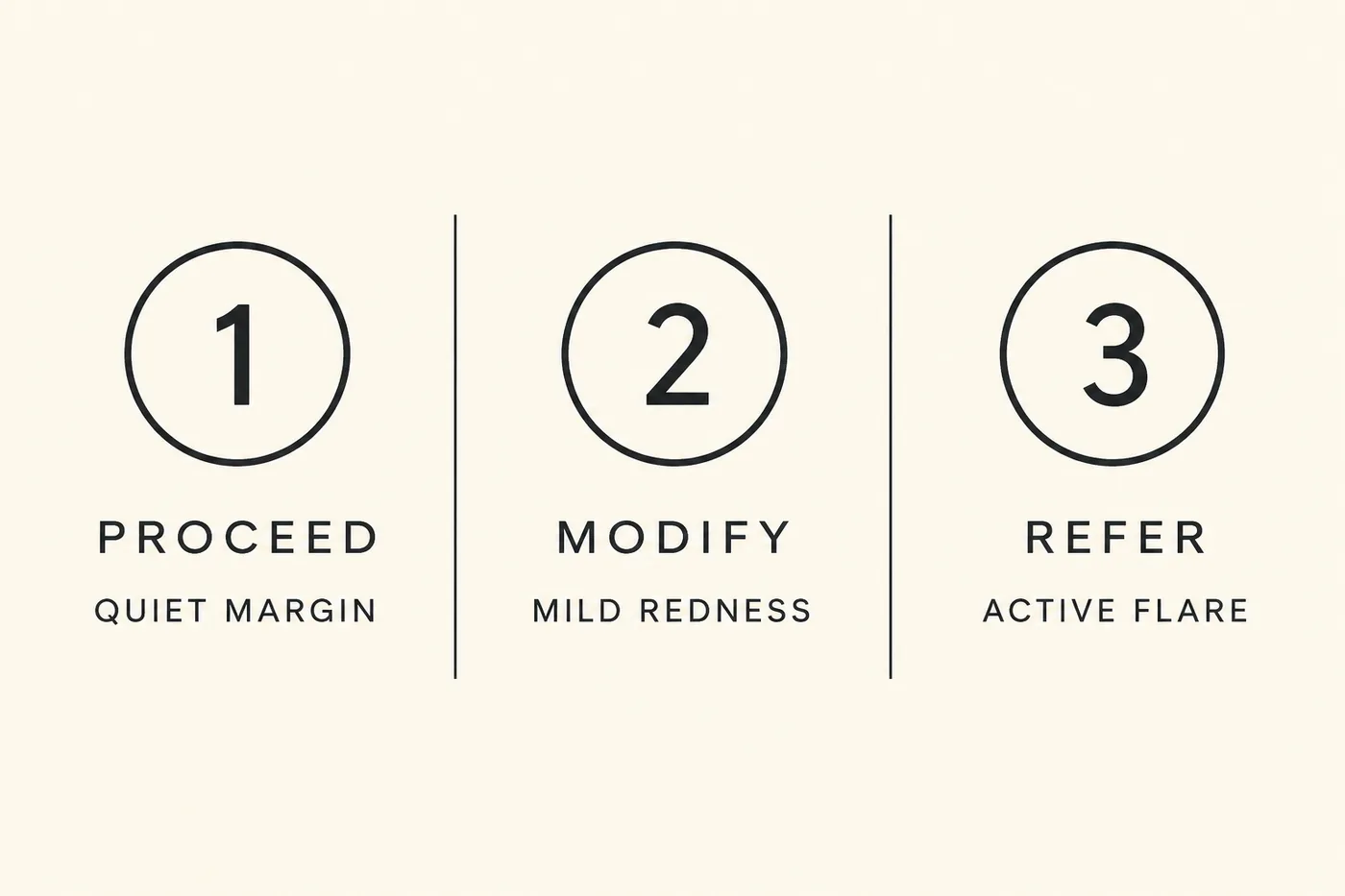
Today’s Decision: Three Outcomes
Every appointment with a known or suspected blepharitis client ends in one of three ways.
Proceed. The margin is quiet, symmetrical, no crusting, no swelling, no debris beyond the ordinary, and the client reports no current symptoms. Standard service, with the aftercare conversation had properly rather than skimmed.
Modify. There is mild margin redness or debris, but no swelling, no pain, no discharge, and the client is established and stable. The reasonable modifications are a lighter set, a shorter length, fewer extensions per lash, and a re-check at the refill. What is not reasonable is adding volume to a lid that is already signalling.
Stop and refer. Active flare – swelling, crusting, pain, discharge, any vision change – or a client who reacts after every set. Remove nothing, apply nothing, and put the observation and the referral in writing the same day. Selling a service into an active flare is the one decision that is indefensible, whatever the client asks for.
The Removal Question
When a client arrives mid-flare wearing a set, the instinct is to take it off immediately. That is often right and it is not automatically so, because removal is itself a mechanical and chemical insult to an inflamed margin.
The defensible sequence is: refer first, and let the clinician decide whether the set stays while the flare is treated, or comes off. If removal is indicated, do it gently, with a gel or cream remover rather than a solvent worked in with pressure, and document what was removed.
What is not defensible is removing a set and applying a new one in the same appointment to “start fresh”. That doubles the insult on the same day.
Prevention That Has Support
Three measures are worth teaching, and only one of them is about products.
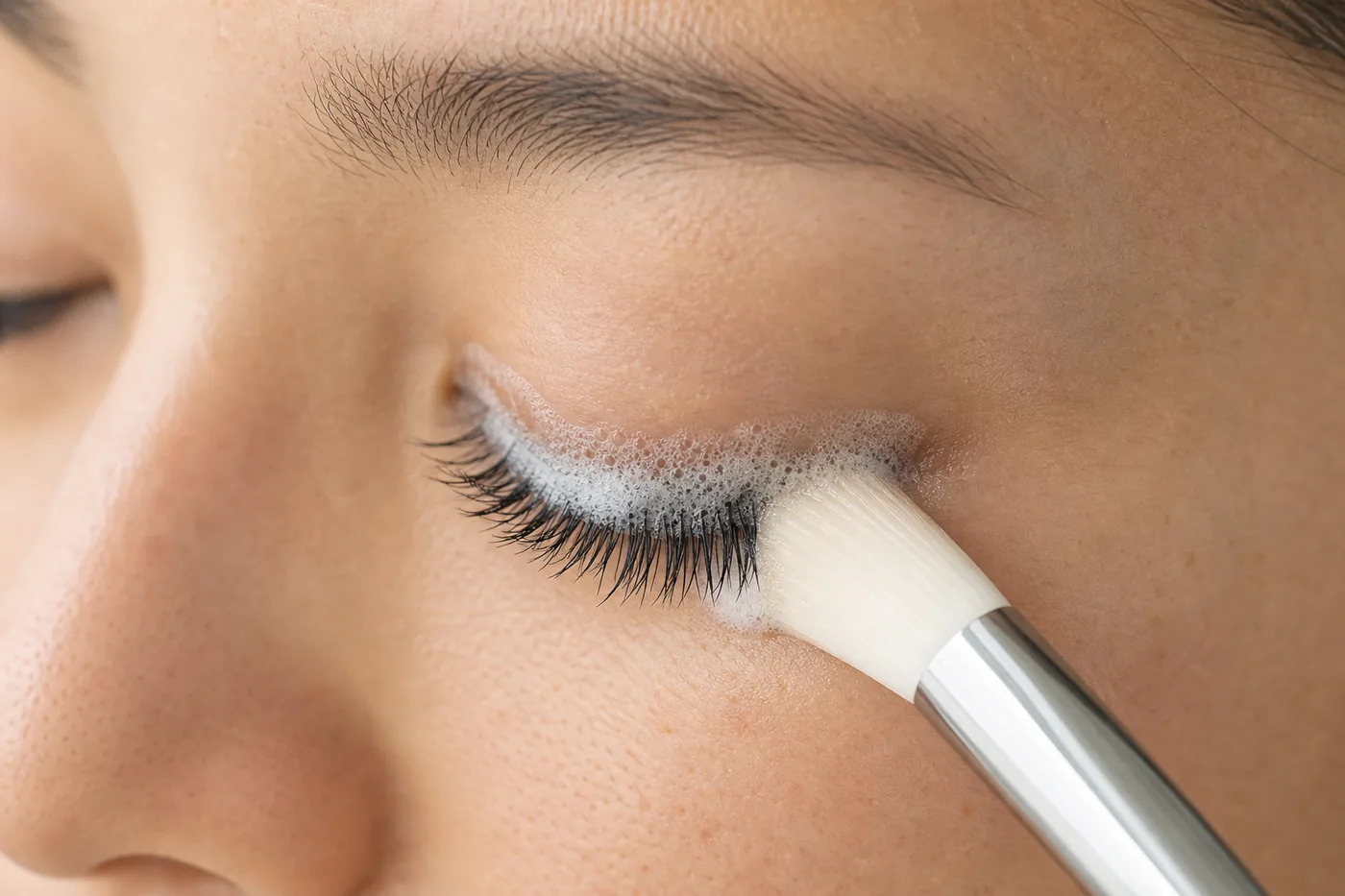
Daily cleansing of the lash line. This is the intervention with the clearest rationale: the pockets only become a problem when what collects in them stays there. The technique matters – downward, with a proper shampoo per ciglia, rinsed rather than wiped – and the wider routine is covered in lash extension aftercare.
Not over-weighting the lash. Heavier sets and longer lengths increase mechanical load at the margin, and load is one of the irritants a client cannot see but a technician controls. The load limits are set out in lash porosity and retention.
Patch testing and recording it. If most reactions are allergic, then the test and the record are the main tools available. A documented patch test, the adhesive batch and the outcome is what lets a technician distinguish “this product” from “this client’s lid” at the next appointment, and the record-keeping structure is set out in the guide to lash extension consent forms.
What does not have support is the idea that a “hypoallergenic” or “sensitive” adhesive removes the risk. Lower-fume formulations exist and are worth choosing for reactive clients, but the sensitisation can develop to any cyanoacrylate, and the mechanism is set out in the guide to colla per occhi sensibili.
Who Should Be Declined
Three groups, and each refusal needs a reason the client can understand.
A client in an active flare, today. A client who has reacted after each of the last two sets, regardless of product changes. A client whose clinician has advised against extensions – in that case the technician is not part of the decision at all.
The fourth group is the one nobody wants to name: clients who cannot or will not cleanse daily. Extensions on an unwashed lash line are the scenario the hygiene mechanism describes, and a technician who has had the conversation twice and seen no change is entitled to decline the service rather than repeat it.

FAQ
Can you have lash extensions if you have blepharitis? Often yes, once the lid is quiet. Blepharitis is frequently chronic, so the workable question is not whether the client has it but whether it is currently active.
Do lash extensions cause blepharitis? They are associated with it rather than proven to cause it. The most commonly reported complication is allergic blepharitis, which suggests the adhesive is the usual trigger rather than hygiene alone.
What should a technician do if a client arrives with a flare? Do not apply. Record what you observe, refer the client to a clinician, and let the clinician decide whether the existing set stays or is removed.
Should extensions be removed during a flare? Not automatically by the technician on the day. Removal is itself an insult to an inflamed margin; the decision belongs with the clinician once the flare is assessed.
Does cleaning lashes daily prevent blepharitis? It addresses the hygiene mechanism and is worth doing regardless, but it does not prevent an allergic reaction to an adhesive.
The Short Version
Blepharitis does not automatically end a client’s lash career, and it does not make a technician responsible for treating it. What it does is move one decision into the technician’s hands: whether the lid in front of them is quiet enough for today’s appointment.
Look at the margin in good light, compare the two eyes, note crusting and swelling, record what the client reports, and refer anything painful, discharging or vision-related the same day. Then decide: proceed, modify, or stop. That is the whole job, and it is enough.
One disclosure: we manufacture lash extensions and adhesives, so we benefit when sets continue. That is why this piece spends more space on when to stop than on when to proceed, and why it points out that most reported reactions are adhesive-related – a conclusion that costs our category more than the hygiene story does.

 English
 German
 French
 Spanish
 Romanian
 Portuguese
 Dutch
 Italian
 Swedish
 Polish