

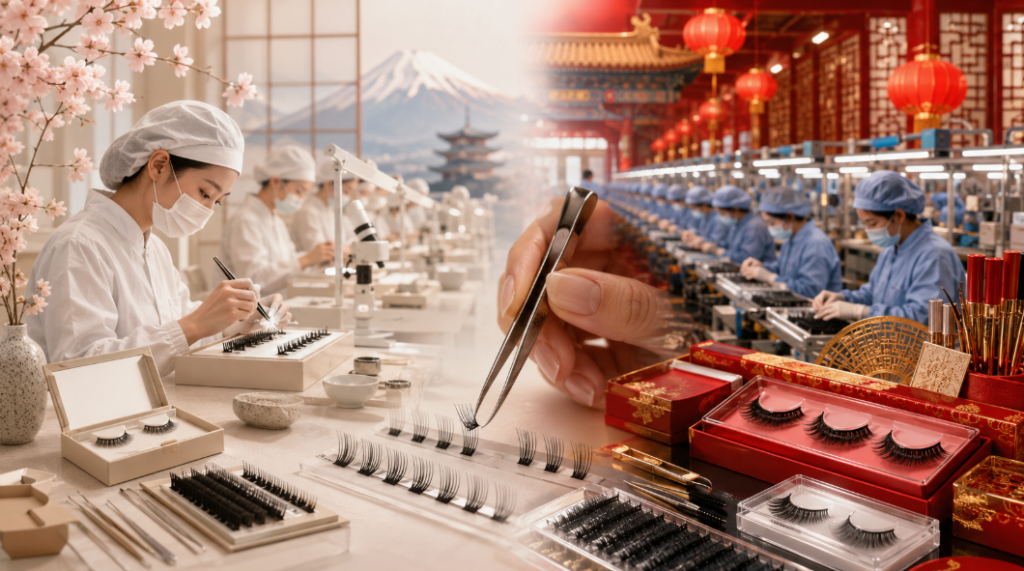
Om du jämför tillverkningsländer för lösögonfransar skiljer sig Japan och Kina vanligtvis mest åt vad gäller positionering: Japan förknippas oftare med förstklassigt hantverk och förfinad presentation, medan Kina typiskt sett är det mer kostnadseffektiva och skalbara alternativet för inköp av fransar i bulk. Det bästa valet beror på om ditt varumärke prioriterar en premiumimage eller produktionseffektivitet.
Översikt över grossistproduktion av lösögonfransar i Japan och Kina
Innan du jämför dem direkt är det bra att förstå hur respektive marknad typiskt sett är positionerad inom fransinköp.
Japan: en exklusiv, nischfokuserad marknad
Japan beskrivs vanligtvis inte som ett tillverkningsnav för fransar i stora volymer. Istället förknippas landet med produktion i mindre skala, premiumpositionering och en starkare betoning på hantverk och produktförfining. Vid inköp av skönhetsprodukter från Japan letar köpare ofta efter fabriker som prioriterar stabil processkontroll, detaljerad ytfinish och förpackningskvalitet framför lägsta möjliga styckkostnad.
Det innebär vanligtvis en snävare leverantörsbas, men en som ofta fokuserar på enhetlighet, finare detaljer och mer exklusiv produktpresentation. För köpare är de mest användbara bevisen inte generella påståenden om “japansk kvalitet”, utan mätbar dokumentation. Fråga om leverantören kan uppvisa:
- ett erkänt kvalitetsledningssystem såsom ISO 9001
- kontroller för kosmetikatillverkning eller GMP-liknande produktionsrutiner
- inspektionsprotokoll för böjningens enhetlighet, bandsymmetri och förpackningsnoggrannhet
- protokoll för provgodkännande före massproduktion
Dessa dokument är viktiga eftersom de visar om leverantören kan upprätthålla en repeterbar kvalitet, och inte bara tillverka ett enstaka bra varuprov.
Kina: en storskalig och kostnadseffektiv bas
Kina är en av de mest etablerade inköpsbaserna för skönhetsprodukter, inklusive lösögonfransar. För grossistköpare förknippas Kina ofta med större produktionskapacitet, bredare produktutbud, snabbare OEM/ODM-stöd och prissättning som oftast är mer konkurrenskraftig än på premiummarknader. Landet väljs också ofta för private label-projekt där kundanpassning är avgörande.
I praktiska inköpstermer jämför köpare ofta kinesiska fabriker utifrån mätbara kriterier som minsta orderkvantitet, ledtid för varuprov, produktionstidsramar och huruvida leverantören kan erbjuda private label-förpackningar. Det är dessa detaljer som avgör om fabriken verkligen lämpar sig för storskalig grossisthandel.
Om leverantören hävdar att den är en etablerad exportör bör köpare efterfråga exportregister, tulldokumentation där det är tillgängligt, eller frakthistorik kopplad till specifika produktkategorier. Det ger ett starkare bevis än generiska marknadsföringsfraser om kapacitet och storlek.
Likheter inom grossistproduktion av lösögonfransar
Trots sina olika marknadspositioner delar Kina och Japan några viktiga egenskaper vid inköp:
- Båda marknaderna kan hantera grossistbeställningar av fransar snarare än enbart detaljhandelsförsäljning.
- Båda används av köpare som värdesätter produktenhetlighet och tillverkningsdisciplin.
- Båda kan hjälpa varumärken som vill utveckla repeterbara fransartiklar (SKU) för långsiktig försäljning.
- Båda marknaderna kan erbjuda stöd för produktutveckling, beroende på leverantör.
- I båda länderna brukar de bästa leverantörerna tillhandahålla provgodkännande före massproduktion, vilket är en viktig kvalitetskontrollpunkt för fransband, böjningsform, bricklayout och tryckprecision på ytterkartongen.
Dessa likheter är viktiga eftersom de visar att den avgörande faktorn oftast inte är om ett land alls kan tillverka fransar, utan om leverantören kan uppfylla köparens exakta specifikation till rätt pris och ledtid.
Skillnader inom bulktillverkning av lösögonfransar
De största skillnaderna mellan Kina och Japan märks inom kvalitetspositionering, produktutbud, prissättning och kundanpassningsmöjligheter.
Produktkvalitet för fransar
Japan förknippas vanligtvis med en mer exklusiv kvalitetsimage, särskilt när köpare söker förfinat hantverk och en oklanderlig finish. I inköpstermer innebär denna premiumpositionering oftast högre krav på fiberlikformighet, bandets rakhet, brickans presentation och enhetlighet från batch till batch.
Kina väljs däremot ofta för pålitlig grossistkvalitet till en mer konkurrenskraftig prisnivå. Det betyder inte att kinesiska produkter håller låg kvalitet; marknaden används snarare i regel av varumärken som vill ha acceptabel till god produktionskvalitet och samtidigt behålla en fördelaktig styckekonomi.
Ett praktiskt sätt att jämföra de två är att utvärdera samma uppsättning varuprover utifrån mätbara kriterier:
- Bandets enhetlighet: ligger varje remsa platt och behåller formen?
- Bevarande av böjning: behåller fransarna den avsedda böjningen efter hantering?
- Fiberlikformighet: är fibrerna jämnt inriktade och likartade i tjocklek?
- Förpackningsprecision: stämmer antal per bricka, etiketter och tryckta specifikationer?
- Defektfrekvens i varuprover: hur många brickor uppvisar oregelbundna fibrer, limrester eller formavvikelser?
Oavsett land beror den slutliga kvaliteten fortfarande på den specifika fabriken, råmaterialen, processkontrollen och orderspecifikationerna. Köpare bör begära varuprover och jämföra fransböjningens enhetlighet, bandtjocklek, fibermjukhet och förpackningsnoggrannhet innan en bulkorder läggs.
En bra inköpsregel är denna: om en leverantör kan uppvisa interna kvalitetskontrollrutiner, en dokumenterad inspektionsprocess eller tredjepartstestning kopplad till relevanta kosmetika- eller förpackningsstandarder, är det ett starkare bevis än enbart generella kvalitetspåståenden. Köpare bör också fråga om leverantörens ersättningspolicy för defekta brickor och om de utför kontroller enligt en AQL-liknande provtagningsplan, eftersom det är praktiska indikatorer på kvalitetsdisciplin.
Produktutbud för lösögonfransar
Har du undrat vilka fransprodukter Kina och Japan erbjuder för bulkbeställningar? I praktiken visar sig skillnaden i sortiment ofta i hur bred leverantörens katalog är och hur snabbt den kan hantera ytterligare artiklar (SKU:er).
- Japan: mer inriktat på exklusiva, förfinade fransalternativ och nischad presentation
- Kina: mer anpassningsbart för ett bredare utbud av grossiststilar och produktutveckling av OEM-typ
- Kina: ofta mer öppet för varumärkesspecifika förpackningar och kundanpassade produktönskemål
- Japan: kan vara bättre för köpare som söker en handplockad katalog med en striktare estetisk standard
Om ditt mål är snabb produktutveckling över flera artiklar (SKU:er) är Kina vanligtvis det mer flexibla alternativet. Om ditt mål är en premiumposition på marknaden med en mindre, mer handplockad katalog kan Japan passa bättre.
Produktprissättning och produktionskostnader
Prissättningen är en av de tydligaste skillnaderna mellan de två marknaderna.
- Kina: utkastkällan anger grossistpriset till cirka $1,5–5,5 per bricka.
- Japan: utkastkällan anger grossistpriset till cirka $3,5–8 per bricka.
Dessa intervall är utgångspunkter och inte fasta marknadspriser, eftersom den slutliga kostnaden beror på franstyp, material, orderstorlek, förpackning och anpassningskrav. En köpare som jämför offerter bör alltid kontrollera om offerten inkluderar kartongmärkning, brickinlägg, logotyptryck, provavgifter och fraktvillkor, eftersom dessa variabler kan påverka den totala hemtagningskostnaden avsevärt.
Kina är generellt sett den mer kostnadseffektiva inköpsdestinationen tack vare lägre arbets- och produktionskostnader. Japan tenderar att vara dyrare eftersom landet är positionerat kring högre standarder, finare hantverk och striktare processkrav.
Vid inköpsbeslut är den mest användbara jämförelsen inte bara styckpriset, utan det totala värdet. Till exempel kan en billigare bricka som levereras med ojämn böjning eller bristfällig förpackning kosta mer i slutändan om den leder till efterarbete eller reklamationer från kunder. Köpare bör därför jämföra priset tillsammans med inspektionsresultat och leverantörens lyhördhet.
Om du vill ha ett tydligare jämförelseunderlag, be båda leverantörerna om samma offertstruktur:
- styckpris per bricka
- orderkvantiteter per stil och per förpackningsdesign
- provavgift och tidsramar för provtillverkning
- tidsramar för massproduktion
- ersättningspolicy vid defekter
- om offerten inkluderar anpassat logotyptryck eller endast neutral förpackning
Det gör prisskillnaden mätbar istället för att bygga på intryck.
Private label och kundanpassningsalternativ
Private label och kundanpassning är viktigt för varumärken som vill sälja under eget namn snarare än som återförsäljare av generiska produkter. Det är vanligtvis här skillnaden mellan de två länderna blir särskilt påtaglig i praktiken.
Kina är vanligtvis det starkare alternativet för köpare som vill ha OEM/ODM-stöd, anpassade förpackningar och mer flexibel produktanpassning. I ett private label-projekt kan det omfatta logotyptryck, kartongdesign, iläggskort, bricklayouter och artikelspecifika etikettformat. Det gör det också enklare för varumärken att bygga upp en produktlinje utan att behöva hålla stora lager av generiska artiklar.
Japan kan också stödja inköp av varumärkesprofilerade fransar, men marknaden är vanligtvis mer selektiv och mer inriktad på premiumpresentation än på kundanpassning i stora volymer. Det gör Japan till ett bättre val när varumärkesimage och produktförfining är viktigare än variation eller lågkostnadsskalning.
Ett praktiskt sätt att bedöma kundanpassningsförmågan är att be varje leverantör om samma specifikationsblad och jämföra:
- minsta orderkvantitet för specialanpassad förpackning
- tidsramar för provtillverkning vid korrigeringar av tryckoriginal
- om fabriken kan trycka streckkoder eller butiksetiketter
- hur många förpackningsalternativ som finns tillgängliga per artikel (SKU)
- om leverantören kan bibehålla samma design vid återkommande beställningar
Om en leverantör kan svara tydligt på dessa frågor och visa prov på detta genom förproduktionsprover, är det ett starkare bevis på verklig private label-kapacitet än generella marknadsföringsfraser.
Representativa inköpsriktmärken att jämföra
Eftersom många marknadspåståenden om inköp av fransar kan låta vaga bör köpare förankra jämförelsen i konkreta leverantörsbevis. Användbara referenspunkter inkluderar:
- Kvalitetsstandarder: ISO 9001 för kvalitetsledning och, där det är relevant, kontroller för kosmetikatillverkning eller GMP-liknande produktionsdokumentation
- Handels- och exportdatabaser: nationella tulldata eller företagets exportregister där det är tillgängligt, vilket kan hjälpa till att bekräfta om en fabrik är en regelbunden exportör snarare än bara en inhemsk återförsäljare
- Branschorganisationer: nationella branschorganisationer inom skönhet eller tillverkning som kan hjälpa till att identifiera etablerade leverantörer
- Produktionsmått att efterfråga: månatlig produktionskapacitet, orderkvantiteter per stil, tidsramar för provtillverkning och typiska tidsramar för bulkproduktion
- Kvalitetsmått att efterfråga: defektfrekvens i inspektionsrapporter, tillvägagångssätt för AQL-provtagning och ersättningspolicy för felaktiga brickor
Om en leverantör inte kan tillhandahålla dessa grundläggande uppgifter bör köpare förhålla sig kritiska till generella påståenden om premiumkvalitet eller storskalig produktion. Be om möjligt om namngivna affärsreferenser i form av företagsregistreringsuppgifter, fabriksrevisionsrapporter eller siffror som kan kontrolleras oberoende. Även om fabriken inte offentliggör varje detalj bör en seriös leverantör kunna förklara hur dess kvalitetssystem fungerar och vilken dokumentation som kan delas under en due diligence-process.
Så väljer du det bästa alternativet för ditt företag
Välj Kina om du vill ha:
- lägre grossistpriser
- större flexibilitet för OEM/ODM
- enklare private label-utveckling
- en inköpsmodell som stöder större eller snabbare skalning
- ett urval av leverantörer som ofta är mer öppna för anpassning av förpackningar och artiklar
Välj Japan om du vill ha:
- en premiumimage på marknaden
- en mer hantverksorienterad produktpositionering
- en kurerad franslinje för varumärkesbyggande i premiumsegmentet
- större tonvikt på produktförfining framför pris
- en inköpsberättelse som stödjer premiumpositionering i din egen marknadsföring
En enkel beslutsregel är följande: om ditt varumärke konkurrerar med volym, marginal och kundanpassning är Kina oftast det mest praktiska valet. Om ditt varumärke konkurrerar med presentation, förfining och premiumkänsla kan Japan vara det bättre strategiska valet.
Viktigaste slutsatsen
Både Kina och Japan har en given plats vid grossistinköp av fransar, men de möter olika affärsmål. Kina är oftast det mer praktiska valet för priskänsliga varumärken och utveckling av egna märkesvaror (private label). Japan är oftast det starkare valet för köpare som prioriterar premiumpositionering och förfinad produktpresentation.
Lashfines praktiska rekommendation är att jämföra leverantörer med samma checklista, samma provkriterier och samma offertstruktur. Det gör att beslutet grundar sig på faktiska fabriksdata snarare än nationella stereotyper.
Om du jämför leverantörer är det säkraste tillvägagångssättet att begära varuprover, jämföra specifikationer sida vid sida och välja den fabrik som matchar din målprisnivå, din varumärkesimage och din ordervolym. Förlita dig inte enbart på anseende på landsnivå; använd mätbara inköpskriterier såsom orderkvantiteter, produktionstidsramar, underlag för kvalitetskontroll, förpackningsprecision och täckning.
Vanliga frågor
Vilket land är bäst för fransbeställningar med låg orderkvantitet?
Kina är ofta mer flexibelt för mer kostnadseffektiv grossistutveckling, men det egentliga svaret beror på fabriken. Vissa japanska leverantörer kan acceptera mindre beställningar för premiumlinjer, medan vissa kinesiska fabriker fortfarande kan kräva betydande orderkvantiteter för kundanpassade förpackningar.
Vilket land är bäst för fransvarumärken inom private label?
Kina är oftast det starkare valet för private label-varumärken eftersom det är vanligare förknippat med OEM/ODM-stöd, förpackningsanpassning och kostnadseffektiv skalbarhet.
Håller Japan alltid högre kvalitet än Kina?
Nej. Japan är generellt positionerat som premium, men kvaliteten beror fortfarande på den enskilda fabriken, råmaterialen, inspektionsprocessen och orderspecifikationen. En välskött kinesisk fabrik kan överträffa en svagare japansk leverantör vad gäller jämnhet.
Hur bör köpare verifiera leverantörers påståenden?
Be om varuprover, produktionsspecifikationer, uppskattade produktionstidslinjer, dokumentation där det är tillämpligt samt skriftliga inspektionsrutiner. Om möjligt, jämför flera leverantörer med hjälp av samma checklista så att prissättning och kvalitet blir lättare att utvärdera på ett rättvist sätt.
Vad är det säkraste sättet att jämföra offerter?
Jämför hela det landade erbjudandet, inte bara priset per ask. Inkludera förpackning, originalarbete, provavgifter, leveransvillkor och ersättningspolicy, eftersom dessa detaljer kan förändra den totala kostnaden och den slutliga riskprofilen avsevärt.

 English
  German
  French
  Spanish
  Romanian
  Portuguese
  Dutch
Dutch  Italian
  Swedish
  Polish