


Lash tech certification is one of the few purchases in this industry where the buyer cannot easily tell what they have bought. A course fee buys instruction, and at the end of it a document arrives with a name, a date and a seal. What that document entitles the holder to do varies enormously – from a genuine skill credential that insurers and clients recognise, to a PDF that says someone watched four hours of video.
The confusion is not accidental. Course sellers use “certification” and “licensing” almost interchangeably in their marketing, because the word certification sounds authoritative and costs nothing to print. The result is a steady stream of people who believe they are legally cleared to work, and a smaller stream who believe a state licence is the same thing as a qualification.
This guide separates the three documents that get muddled – licence, certificate and insurance – sets out what a certificate can and cannot prove, and gives a way to judge a course before the fee is paid rather than after.
What a Lash Certificate Actually Proves
A certificate is a record that the holder completed a specific course. That is all it is, and it is more useful than it sounds, because what the course covered is what the certificate speaks to.
If the course included supervised practical work on models, an assessment that could be failed, and aftercare and consultation training, then the certificate is evidence of a real skill threshold. If it included none of those, the certificate is evidence that a payment cleared. Both documents look similar on a wall, which is exactly why the assessment matters more than the certificate.
The scope also narrows what the certificate covers. A classic lash certificate does not certify volume work, and a volume certificate does not certify mega volume or lash lifts unless those were taught and assessed. Technicians who collect certificates often assume they stack into a general qualification; they do not. Each one describes the specific training it names.
None of this is a reason to skip certification. It is a reason to read what is being certified rather than the word on the front.
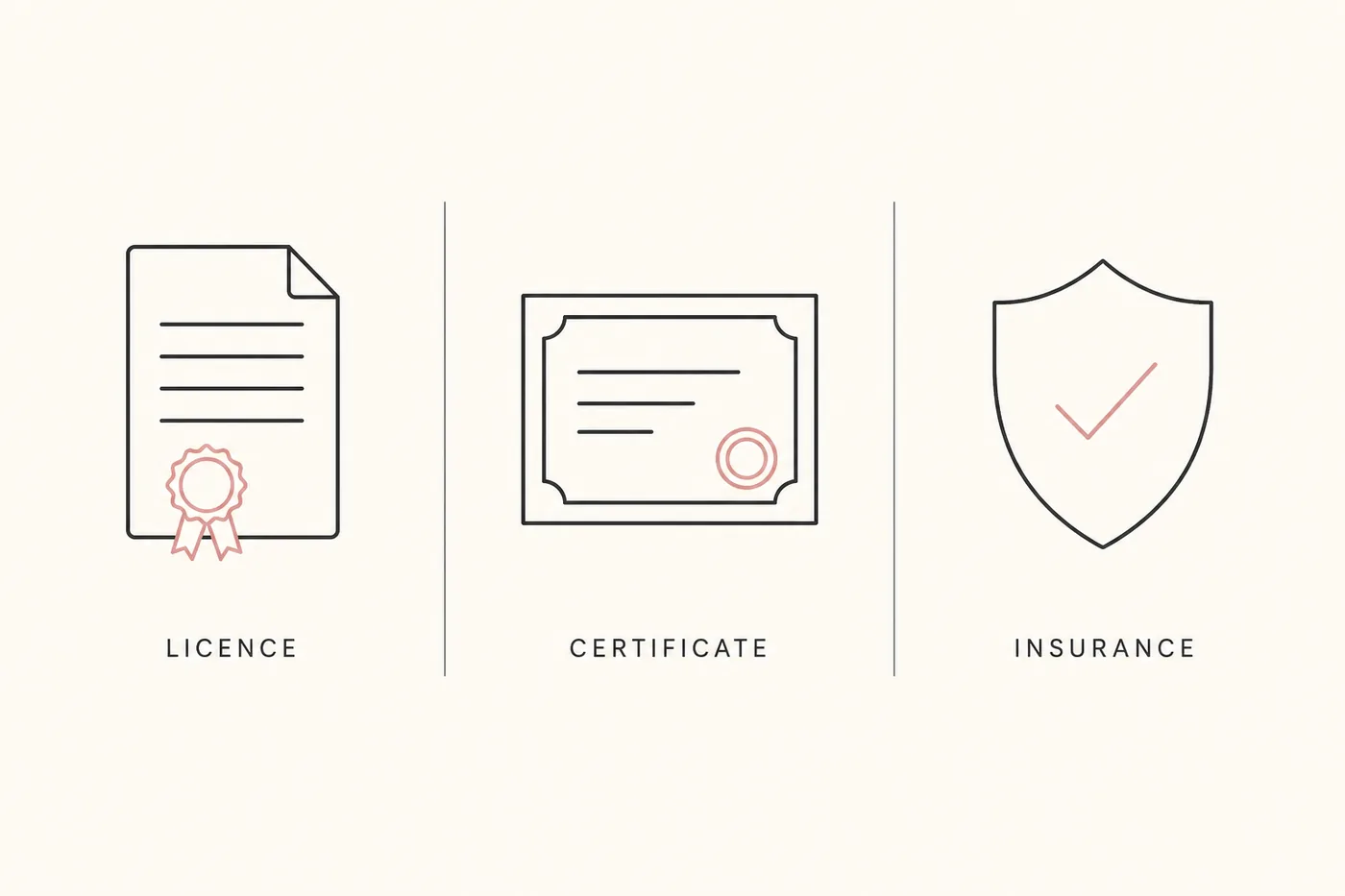
Licence, Certificate and Insurance: Three Different Things
These three are routinely treated as one requirement, and each does a different job.
A licence is a legal permission to practise. It comes from a state board, it has requirements that exist independently of any course, and working without one where it is required is a regulatory offence rather than a quality issue. A certificate does not substitute for it, and no training provider can grant it.
A certificate is evidence of training. It is issued by a school or a trainer, it has no legal force on its own, and its value depends entirely on what was taught and assessed. It is the document that tells a client or an insurer what the holder has been trained to do.
Insurance is cover for when something goes wrong. Most policies for lash work ask for evidence of training before they will quote, which is where the certificate becomes commercially useful. Insurance does not legitimise unlicensed practice, and a licence does not remove the need for cover.
The order matters. Licence first where the state requires one, certificate as the training record, insurance before the first paying client. Buying a certificate in the hope that it satisfies a licensing requirement is the single most expensive misunderstanding in this list.
Your State Comes Before Any Course
Lash regulation is set at state level, and the differences are large enough that advice from a forum in another state is worse than no advice.
Some states require a dedicated lash licence. Texas is one: lash work there is covered by a specialty licence, and a certificate alone carries no legal standing. Some states regulate lash work through existing esthetics or cosmetology licences, which means the requirement is a broader qualification rather than a lash-specific one – New York works this way, with an esthetics or cosmetology licence required to practise legally. Others use an approved-training route, and a few have no separate requirement at all beyond general business rules.
The practical sequence is therefore unglamorous and always the same: find the state board that regulates the work, read its current requirement, and only then look at courses. A course that is excellent in one state may be irrelevant in another, and no trainer can overrule a board.
Two of the state-level situations are covered in more detail elsewhere on this site: the California route and the Arizona licensing and board rules. The broader career sequence, including the steps either side of training, is set out in como se tornar um técnico de cílios.
What a Course Has to Contain to Be Worth the Fee
Judged as a training product rather than as a certificate, a lash course has a small number of components that decide whether it produces a working technician.
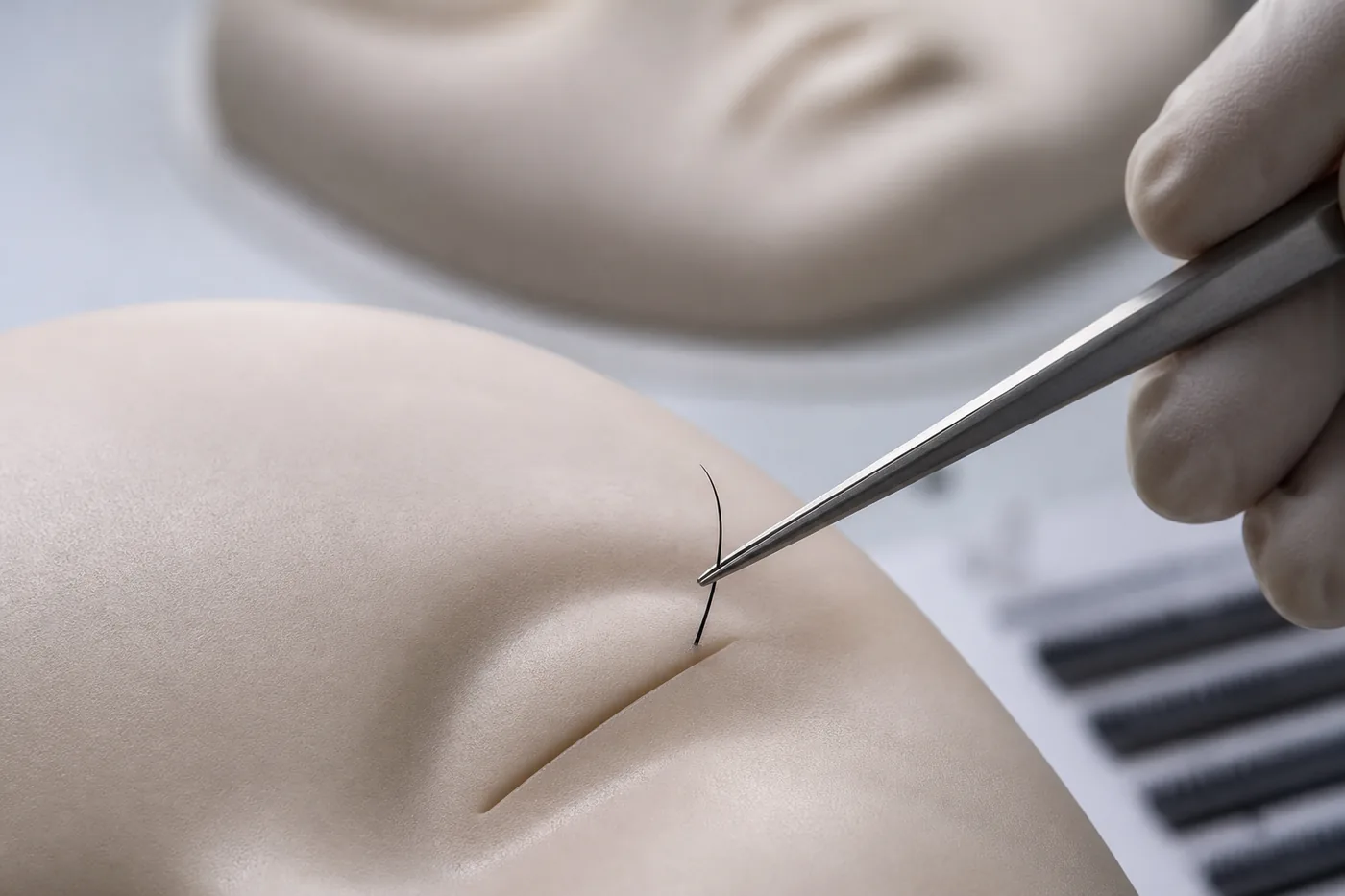
Supervised practical hours are the core. Watching a technique and performing it under correction are different activities, and only the second one transfers. The useful question is not “how many hours” but “how many of those hours am I working on a model with someone correcting me”.
Model work is the second. A course that never puts the student in front of a live lash line leaves the hardest part – isolation on a moving, blinking client – for the student to discover alone.
Assessment is the third, and it is the one most often missing. A course that cannot be failed is not assessing anything, and its certificate carries no information. Practical sign-off against a defined standard, even a simple one, is what separates training from attendance.
The fourth is the content around the technique: consultation, contraindications, patch testing, aftercare instruction, and what to do when a client reacts. These are the parts of the job that generate complaints and claims, and they are routinely compressed into a handout.
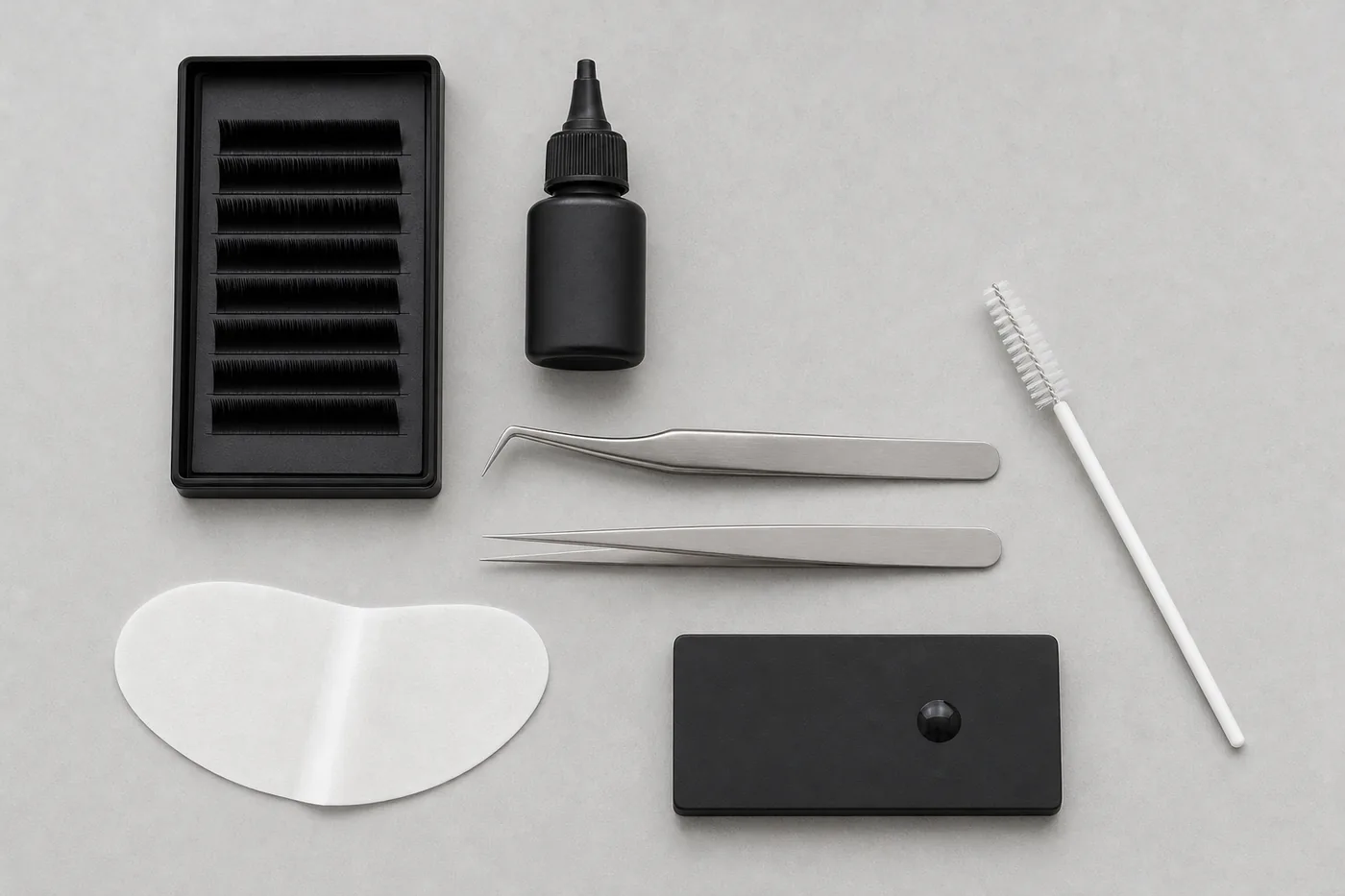
The fifth is what the student leaves with – not the certificate, but the ability to book a client. That usually means a kit good enough to work with, and a reason to believe the first set will be passable. Practising between the course and the first paying client is where most of the skill actually forms, and the tools for that are covered in the guides to Pinça para cílios e lash brushes.

The Red Flags That Repeat Across the Industry
The same handful of patterns shows up in weak courses, and they are visible before payment.
Instant certification is the clearest. A credential issued on completion of video modules with no practical component is a record of watching, and it will not satisfy an insurer or a state board that asks for training evidence.
Accreditation claims without a named body are the second. “Fully accredited” means something specific – accredited by whom, for what – and a course that will not name the accrediting organisation is usually using the word as decoration.
Assessment that cannot be failed is the third. If every enrolled student receives the same certificate regardless of output, the certificate says nothing about the holder.
Earnings guarantees are the fourth. Any claim that a course leads to a specific income is a marketing statement about the market, not a property of the training, and it is a reliable signal that the course is being sold rather than taught.
A fifth pattern is a curriculum that covers only application. Courses that skip consultation, patch testing, aftercare and the business basics produce technicians who can place lashes and cannot run a service.
What Certification Cannot Do
A certificate does not make an unlicensed technician legal where a licence is required. It does not replace insurance. It does not expire into nothing either – most certificates do not lapse, which is why a ten-year-old certificate is often presented as current evidence of a skill that has never been used.
It also does not guarantee that the holder can work at commercial speed. A course teaches a technique; speed and consistency come from repetition, and the gap between a certificate and a bookable service is measured in sets, not in documents. That gap is also where most of the money is spent on supplies that turn out to be the wrong specification, which is a separate problem covered in the material on preparing a lash business.
The honest framing for a client or an insurer is that a certificate describes training, a licence describes permission, and a portfolio describes ability. All three are asked for at different moments, and none substitutes for the others.
If You Are Already Working
Established technicians buy certificates for a different reason: advanced techniques that the initial course did not cover, and evidence for insurers or salons that a specific skill has been taught.
Volume, mega volume, lash lifts and styling specialisms are the common ones. The same tests apply, with one addition: for an experienced technician the value is almost entirely in the practical correction, so a course with no hands-on component is worth close to nothing regardless of the certificate. A technique can be learned from video, but the errors that matter are the ones the student cannot see in their own work.
PERGUNTAS FREQUENTES
Do I need a licence or just a certification? It depends on the state. Some require a dedicated lash licence or an esthetics/cosmetology licence; a certificate alone does not satisfy those requirements. Check the state board before paying for any course.
Is an online lash certification valid? It is a valid record of completing that course, and little more. It generally will not satisfy a licensing requirement, and insurers often ask for practical training evidence.
How long does a lash certification last? Most certificates do not expire. That is a reason to keep evidence of recent training if you have been away from the technique, not a reason to treat an old certificate as current proof of skill.
Can I get insurance without a certificate? Most insurers ask for training evidence before quoting. Requirements vary by provider, so the question to ask is what specific evidence they accept.
Does a certificate let me teach? No. Teaching is usually a separate matter, and in many places it sits under the same licensing rules as practising, with additional requirements.
The Short Version
Certification is a training record, a licence is a legal permission, and insurance is cover – three documents, three jobs, and no overlap. The order to solve them in is state requirement first, training second, insurance before the first client.
Judged properly, a certificate is only as good as the assessment behind it. A course that can be failed, that puts the student on a model under correction, and that teaches the parts of the job beyond application produces a certificate worth showing. One that cannot is a receipt with a border.


 English
 German
 French
 Spanish
 Romanian
 Portuguese
 Dutch
 Italian
 Swedish
 Polish