


Mega volume lashes are usually sold as a number: 8D, 10D, 12D, sixteen fibres per fan. That number describes how many extensions sit on one natural lash, and it is the least useful specification in the whole set. The number that decides whether a mega set survives the week is not the fan count at all – it is the size of the base where those fibres meet the natural lash, and the amount of adhesive sitting in it.
This is the failure mode that makes technicians give up on mega volume. The fans look correct on the tile, they are placed carefully, and the set photographs well on the day. Ten days later half of it is gone, and the reflex is to blame the adhesive or the client. In most cases the set was built past what the natural lash could carry at the base, and no adhesive choice repairs that.
This guide covers what mega volume actually specifies, why the base is the limiting component, why 0.03 diameter is what makes the technique possible at all, where it fails on the client, and what a range needs to stock to support it.
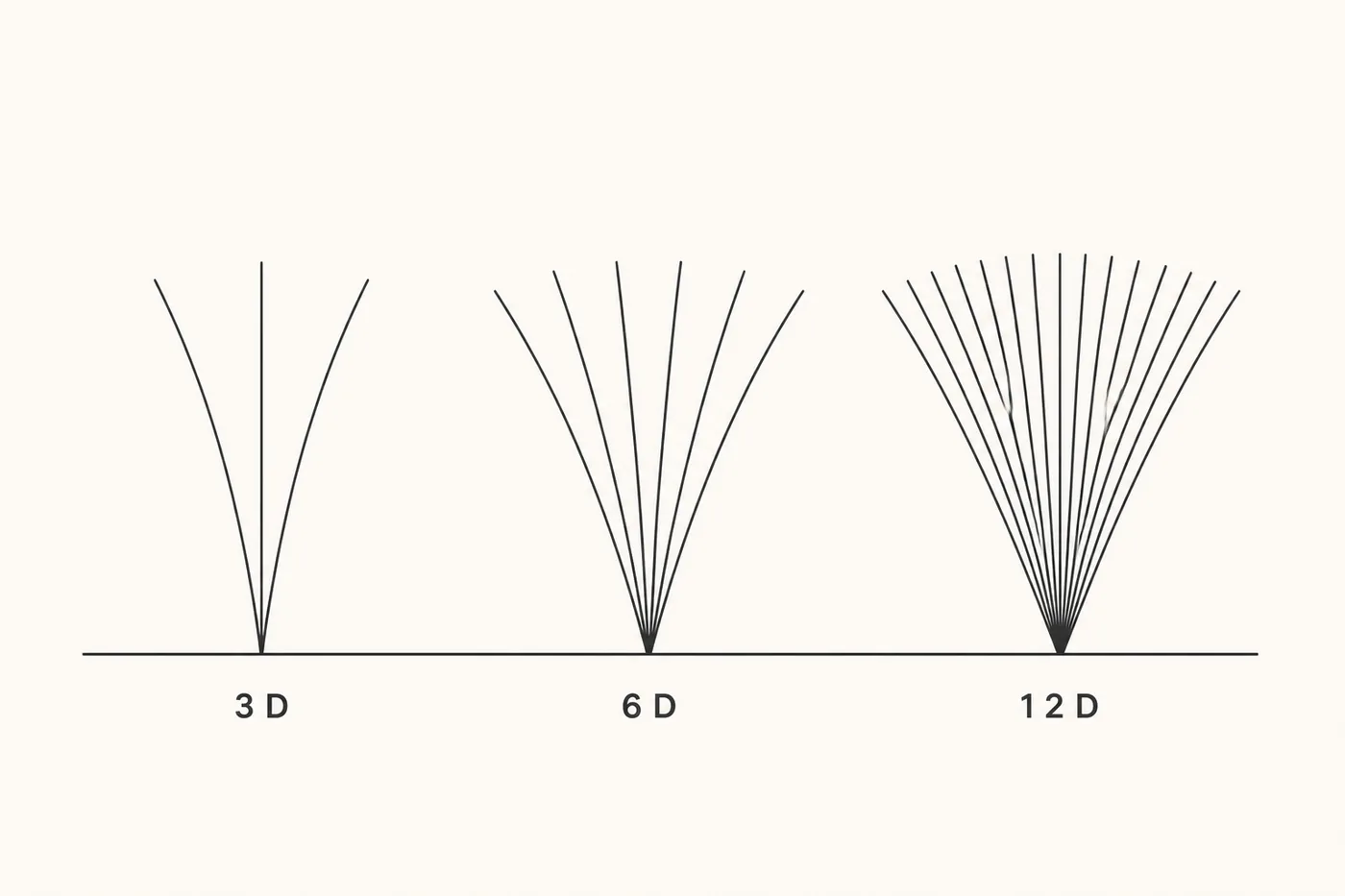
What “Mega” Actually Specifies
Volume work is described by the number of extensions in each fan: a 3D fan holds three fibres, a 5D fan holds five. The convention that separates volume from mega volume is roughly where that count passes six per natural lash, and trays are commonly sold as 8D, 10D and 12D, with higher counts available on request.
What the naming does not tell you is the diameter those fibres are made in. A 10D fan built from 0.07 fibre and a 10D fan built from 0.03 fibre carry the same name and completely different loads. This is why two technicians can order “mega volume lashes”, get identical labels, and produce sets with entirely different lifespans.
The specification that matters is therefore a pair, not a number: fan count plus diameter, and from those two, the total fibre cross-section resting on one lash. A mega set is not defined by being dense. It is defined by achieving density while keeping that total inside what the lash can hold.
The Base Is the Limit
Every fan, however many fibres it contains, has to attach to one natural lash through a single footprint at the base. That footprint has two constraints.
The first is contact area. Adhesive needs enough lash surface to bond to, and the base of the fan has to sit against that surface rather than perch on top of it. A very wide fan base spreads across the lash and can lift at the edges, which is the beginning of a pop-off. A very narrow one concentrates load on a small area and can rotate.
The second is weight distribution. A fan is not resting on the lash like a shelf; it is cantilevered out from the base, so the further the mass sits from the bond point, the more leverage it exerts. Longer lengths in a mega set therefore load the base more than shorter ones of the same count, which is why a 12D fan at 14mm behaves nothing like a 12D fan at 9mm.
The practical consequence is counter-intuitive. Adding fibres to a fan is not the main risk. Adding length to a fan that already carries a high count is, because it multiplies the leverage at the same footprint. A technician moving a client from volume to mega usually gets a better result by holding the length and raising the count than by doing both.
Why 0.03 Diameter Is the Enabling Spec
Mega volume exists because fibre diameter got thin enough to make it possible. At 0.03 the individual fibre is fine enough that a fan of eight to twelve can be built without the resulting bundle becoming a solid mass at the base.
That same thinness is the source of most mega-specific problems. Fine fibre is more fragile in the fan, more sensitive to how much adhesive is drawn into the base, and less forgiving of a slow placement – it starts to close before it is seated. Technicians who can build a clean 0.07 fan often find their first mega set collapses at the base, not because the technique is wrong but because the fibre behaves differently at that diameter.
It also changes the visual result in a way that matters commercially. Thin fibre in high counts reads as a soft, dense veil rather than as individual lashes. That is the look mega clients are buying, and it is also why a mega set built from heavier fibre looks like a cluster set instead.

Where Mega Volume Fails on the Client
Four client profiles produce disappointing mega sets regardless of technique.
The first is the client with sparse natural lashes. Fan count assumes a lash strong enough to carry it. On a thin lash line, the correct answer is usually a lower count at a shorter length, and pushing to mega produces early loss that the client reads as a bad set.
The second is the client whose natural lashes point downward. Mega adds weight in the direction the lash is already going, so the result is heavier, not more open. Base curvature and direction have to be solved before density is added.
The third is the client with very short natural lashes. A twelve-fibre fan needs a base long enough to sit on; on a short lash the fan overhangs the tip and the bond is compromised from the first day.
The fourth is the client who wanted a spiky, textured look and was sold density instead. Mega volume is uniform by design. Textured results come from mixing counts and lengths deliberately, which is a different specification and a different conversation at consultation.
Isolation and Adhesive Discipline
Two habits decide whether a well-built mega set holds, and both are harder at high counts than they are in classic work.
Isolation gets more difficult because the working area at the base is crowded. A fan placed across two natural lashes will be pulled apart by ordinary movement, and at twelve fibres the resulting loss is visible immediately. The check is the same as in any volume work, but the tolerance for error is lower: at 0.03 a small stick is harder to see and more damaging.
Adhesive discipline matters more than usual because the base is the constraint. More adhesive does not create more surface. It creates a larger cured mass, which adds weight at exactly the point that is already loaded, and it can wick up the fan and close it. The reference point is the amount that wets the base and no more, which is covered in the note on preparing the natural lash before placement, and the way substrate condition changes what adhesive can achieve is set out in the material on lash porosity and retention.
The bond itself is not different in kind from any other set. What changes is the load it carries, and the general mechanics of how a bond fails are covered in the Lash-Bonder-Leitfaden.
Handmade or Premade for Mega
Mega volume is the technique where the handmade-versus-premade decision has the largest effect on a working day, and the trade-off is worth stating in hours rather than in preference.
Handmade fans give control over count, length and taper per placement, which is what textured and mixed sets need. They also cost time per fan that scales badly: a twelve-fibre fan is not twice as slow as a six-fibre fan to build, it is slower in a way that compounds across a full set.
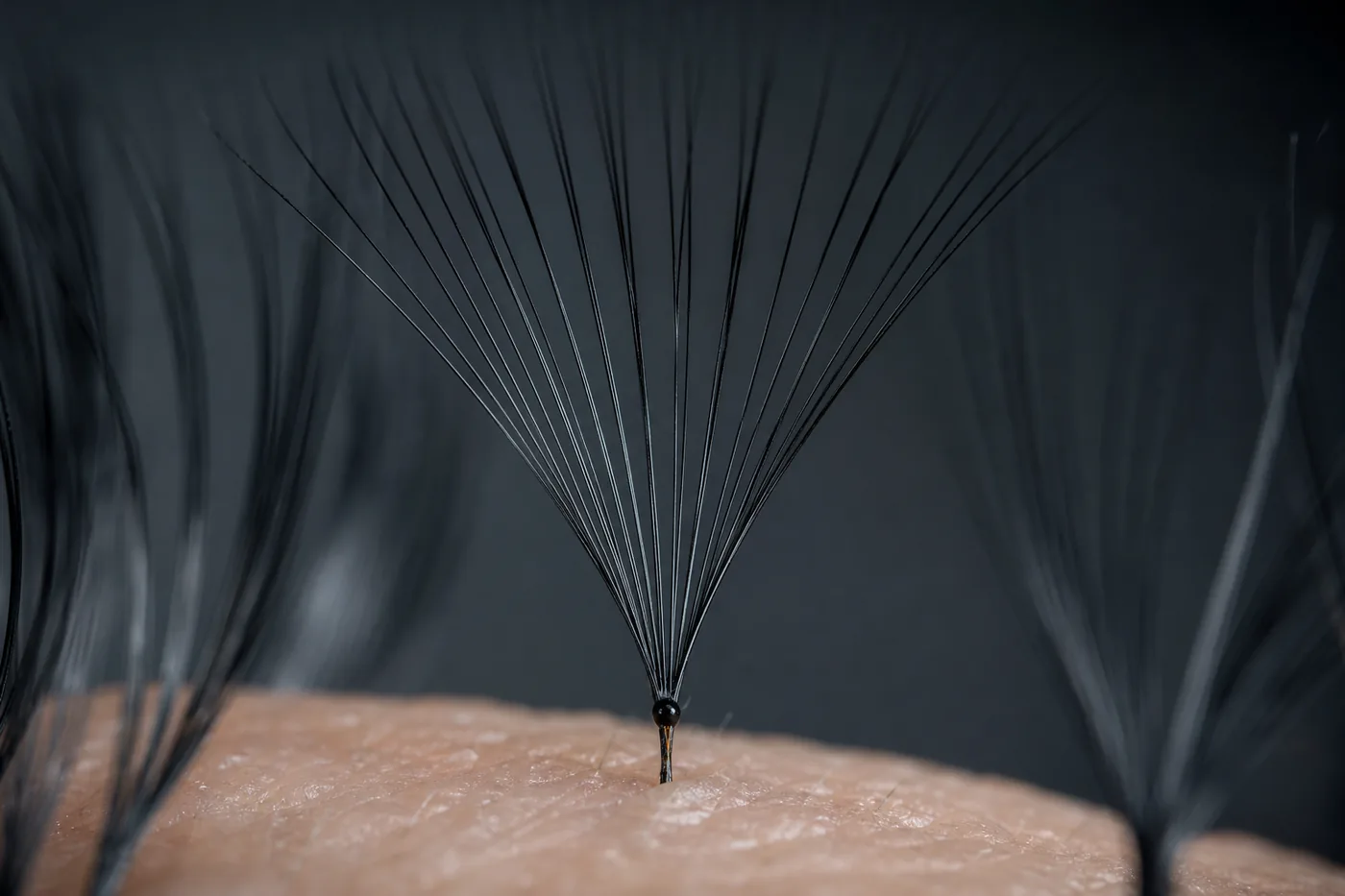
Premade fans remove that cost. A tray of 8D or 12D fans can be picked and placed directly, which is the difference between a mega set fitting into a standard appointment slot and overrunning it. The cost is flexibility – the fan is whatever the tray says it is – and a base that is thicker than a handmade fan of the same count, because the fibres are bonded together at manufacture.
The practical split most technicians land on is premade for the bulk of the set and handmade for the accents that carry the design. The wider comparison, including how the two are packaged and priced, is set out in Premade- vs. Promade-Wimpernfächern and in the guide to easy fanning, which covers the fan-building method that sits between the two.

Stocking a Mega Range
A mega range does not need to be wide. It needs to be deep in a narrow band, because the technique concentrates on one diameter and a small set of curls.
0.03 is the core diameter, with 0.05 used for clients who want the density but cannot carry the finest fibre. Curl usually narrows to the two or three the technician actually uses for this look rather than the full range, since mega is chosen for a specific aesthetic rather than for everyday variety.
Length is where a mega range is most often over-stocked. High counts at long lengths are the least-used combination and the most likely to sit in the drawer, while the middle lengths turn over quickly. The general logic of how diameter, curl and length interact as a specification set is covered in the classic lash extensions guide, and it applies with more force at mega counts because the load compounds.
The one specification worth buying in depth is the premade fan tray. That is the item that determines how many mega sets a technician can physically deliver in a week, and it is the first thing to run out.
FAQ
How many lashes are in a mega volume fan? Conventions vary by supplier, but mega volume is generally understood as six or more extensions per natural lash, with 8D, 10D and 12D the common tray specifications. What matters more than the count is the diameter those fibres are made in.
Is mega volume safe for natural lashes? It is safe when the fan count, length and diameter are matched to the lash carrying them. The risks come from exceeding what the base can support, from bonding across two lashes, and from using more adhesive than the base needs – all of which are technique decisions, not properties of the technique itself.
Can I do mega volume with 0.05 instead of 0.03? Yes, at lower counts. 0.05 allows density on clients whose lashes will not carry 0.03 in high counts, and it is more forgiving to place. The look is slightly heavier and less veil-like.
How long does a mega volume set take? It depends on whether the fans are handmade or premade, and on the technician’s isolation speed. This is the main commercial argument for premade trays: they change the appointment length rather than the result.
Why does my mega volume set fall out faster than my volume sets? Almost always the base rather than the fan. Check for fans bonded across two lashes, for length that is too long for the count, and for adhesive that has been used to compensate for a placement that was not fully seated.
The Short Version
Mega volume is a specification problem disguised as a density decision. The fan count is the visible part; the base footprint, the diameter and the length are what determine whether the set holds. A technician who treats the count as the goal will keep rebuilding the same set; one who treats the base as the constraint can deliver mega volume that behaves like a normal set on the client’s lash line.
For a range supporting this work, the narrow deep buy beats the wide shallow one: 0.03 as the core diameter, a short list of curls actually used for the look, middle lengths in depth, and premade fan trays in the quantities a working week demands.


 English
 German
 French
 Spanish
 Romanian
 Portuguese
 Dutch
 Italian
 Swedish
 Polish