
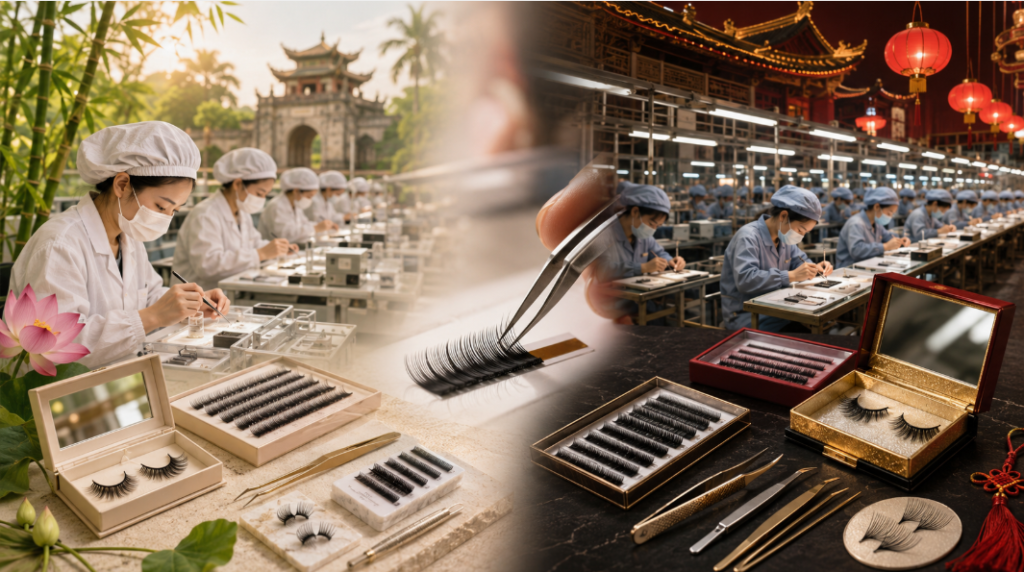
China ist in der Regel die bessere Wahl für Wimpernmarken, die auf Skaleneffekte, eine größere Produktvielfalt, eine schnellere Beschaffung von Mehrkomponentenprodukten und umfassendere Unterstützung bei der Verpackung angewiesen sind. Vietnam eignet sich oft besser für Einkäufer, die niedrigere Arbeitskosten, eine spezialisierte Produktion von Wimpernverlängerungen, handgefertigte Produkte und eine Diversifizierung der Lieferkette anstreben.
Einleitung
Für Wimpernmarken ist die Wahl zwischen Vietnam und China nicht nur eine Frage des Preises. Sie wirkt sich auf die Produktvielfalt, die Geschwindigkeit der individuellen Anpassung, die Mindestbestellmenge, die Flexibilität bei der Verpackung, die Lieferzeit und die Frage aus, wie einfach der Übergang von Mustern zur Serienproduktion ist.
Für Marken wie Lashfine, Diese Entscheidung bestimmt auch, wie einheitlich eine Eigenmarken-Wimpernlinie über Wimpernstreifen, Wimpernbüschel, Verpackungen und Zubehör hinweg ausgebaut werden kann, ohne dass die Qualitätskontrolle darunter leidet. China ist der größere und ausgereiftere Produktionsstandort für Wimpernprodukte. Vietnam ist eine kleinere, aber wachsende Alternative, die oft aufgrund wettbewerbsfähiger Arbeitskosten und der Flexibilität bei Eigenmarken in Betracht gezogen wird. Dieser Vergleich konzentriert sich auf Wimpernverlängerungen, vorgefertigte Fächer, Streifenwimpern und verwandte Eigenmarkenprodukte, die von Salons, Online-Shops, Großhändlern und Ausbildungsakademien verwendet werden.
Übersichtstabelle
| Faktor | China | Vietnam |
|---|---|---|
| Arbeitskosten | Im genannten Vergleich höher als Vietnam; eine Quelle gab etwa US$6,5/Stunde in China im Jahr 2020 | Im genannten Vergleich unter China; eine Quelle gab etwa US$3/Stunde in Vietnam im Jahr 2020 |
| MOQ | Oft niedrig bei Lagerware; höher bei Sonderverpackungen oder OEM-Produkten | Oft flexibel für kleine und mittlere Eigenmarken-Abnehmer; variiert je nach Fabrik |
| Lieferzeit | Bei komplexen Bestellungen in der Regel schneller dank einer gut ausgebauten Lieferkette | Kann bei gezielten Aufträgen wettbewerbsfähig sein, allerdings müssen bestimmte Materialien möglicherweise extern beschafft werden |
| Typische Produktkategorien | Wimpernverlängerungen, vorgefertigte Fächer, Easy-Fan-Wimpern, YY-Wimpern, W-Wimpern, flache Wimpern, farbige Wimpern, Magnetwimpern, Wimpernstreifen, Cluster-Wimpern, Wimpernshampoo, Pinzetten, Verpackungsboxen | Wimpernverlängerungen, handgefertigte Fächer, vorgefertigte Fächer, Private-Label-Trays, Wimpernprodukte aus weicher PBT-Faser |
| Am besten geeignet | Umfangreiche Sortimente, umfassende Eigenmarkenprogramme, bestellungen mit hohem Zubehöranteil, Beschaffung großer Mengen | Start-up-Marken, spezialisierte Wimpernverlängerungsprodukte, handgefertigte Produkte, Ausweichbezugsquellen |
1. Branchenweite und Reife der Fertigung
China verfügt über das größere und ausgereiftere Ökosystem für die Wimpernherstellung. Pingdu in der Provinz Shandong wird weithin als bedeutendes Produktionszentrum für künstliche Wimpern bezeichnet, und chinesische Staatsmedien berichten, dass in dieser Region ein großer Teil der weltweit hergestellten künstlichen Wimpern produziert wird, wobei Tausende von Unternehmen und Zehntausende von Arbeitnehmern in der lokalen Wimpernindustrie tätig sind. Diese Konzentration zeigt, wie spezialisiert Chinas Lieferkette für Wimpern mittlerweile ist.
Diese Bandbreite ist für Käufer wichtig, da sie die Beschaffungsmöglichkeiten erweitert. In China können Marken oft ein breites Produktsortiment auf einem einzigen Markt beziehen: klassische Wimpernverlängerungen, vorgefertigte Fächer, Easy-Fan-Wimpern, YY-Wimpern, W-Wimpern, flache Wimpern, farbige Wimpern, Magnetwimpern, Streifenwimpern, Cluster-Wimpern, Wimpernshampoo, Pinzetten, Verpackungsboxen und zugehöriges Zubehör. Für Einkäufer, die mehrere Artikelnummern und aufeinander abgestimmte Verpackungen benötigen, ist diese Breite ein praktischer Vorteil.
Die vietnamesische Wimpernindustrie ist zwar noch klein, wächst aber stetig. Viele vietnamesische Anbieter konzentrieren sich auf Wimpernverlängerungen, handgefertigte Wimpernbüschel, vorgefertigte Wimpernbüschel und Eigenmarkenprodukte. Im Vergleich zu China gibt es in Vietnam zwar weniger große Wimpern-Cluster, doch das Land hat als alternativer Beschaffungsstandort für Marken, die ihre Lieferantenbasis diversifizieren möchten, zunehmend an Bedeutung gewonnen.
Aus Sicht der Einkäufer liegt der Unterschied nicht nur in der Größe, sondern auch in der Tiefe der Lieferkette. In China kann eine Marke oft von der Musterentwicklung über die Verpackung und das Zubehör bis hin zur Nachlieferung alles aus einer Hand abwickeln, ohne den Lieferanten oder den Markt wechseln zu müssen. In Vietnam finden Einkäufer zwar bei ausgewählten Wimpernkategorien einen starken Service auf Fabrikebene, doch das umgebende Ökosystem ist in der Regel weniger umfassend.
2. Arbeitskosten und Produktionskosten
Die Herstellung von Wimpern ist nach wie vor arbeitsintensiv, insbesondere bei handgefertigten Wimpernfächern, dem Anbringen von Wimpernstreifen, der Qualitätskontrolle und der Verpackung. Daher machen die Arbeitskosten einen wesentlichen Teil der Gesamtkosten aus.
Ein von Vietnam Briefing veröffentlichter Vergleich ergab, dass Chinas durchschnittliche Arbeitskosten pro Stunde höher waren als die Vietnams, wobei Zahlen von etwa 1,65 US-Dollar pro Stunde in China gegen 1,04 US-Dollar pro Stunde in Vietnam im Jahr 2020. Vor diesem Hintergrund kann Vietnam für arbeitsintensive Produktionsschritte wie die handgefertigte Wimpernverarbeitung attraktiv sein.
Allerdings sind die Arbeitskosten nur ein Faktor unter vielen und nicht der entscheidende Faktor. Niedrigere Stundenlöhne führen nicht automatisch zu einem niedrigeren Endpreis. Die endgültige Preisgestaltung hängt auch von Rohstoffen, Ausbeutequoten, Verpackungskosten, Prüfstandards, der Effizienz der Fabrik und den Versandkosten ab. Chinas größere Marktgröße, das ausgereifte Lieferantennetzwerk, der Zugang zu Rohstoffen, die Verfügbarkeit von Verpackungsmaterialien und die logistische Tiefe können einen Teil des Lohnunterschieds ausgleichen. Bei standardisierten Produkten oder Großaufträgen können chinesische Fabriken dennoch wettbewerbsfähige Preise anbieten, da sie ihre Gemeinkosten auf größere Produktionsmengen verteilen können.
Für Käufer, die Angebote vergleichen, lautet die entscheidende Frage nicht nur: “Welches Land ist günstiger?”, sondern auch: “Was ist im Angebot enthalten?” Ein niedrigerer Stückpreis in einem Land schließt möglicherweise Verpackung, Etikettierung oder Nachbearbeitung aus; ein etwas höheres Angebot in einem anderen Land umfasst möglicherweise ein umfassenderes Leistungspaket.
3. Produktvielfalt und Anpassungsmöglichkeiten
Chinas größte Stärke ist die Produktvielfalt. Da die Lieferkette gut ausgebaut ist, können chinesische Fabriken in der Regel eine größere Auswahl an Wimpernformen, Längen, Stärken, Tray-Formaten, Fasertypen, Logodruck, Verpackungsoptionen und Zubehörpaketen anbieten. Ein Einkäufer, der eine komplette Eigenmarkenlinie aufbaut, benötigt möglicherweise Wimpern, Schachteln, Aufkleber, Schulungssets, Wimpernshampoo, Entferner, Primer, Pinzetten, Kleberinge und Displayverpackungen. China eignet sich oft besser für diese Art der Beschaffung aus einer Hand, da die entsprechenden Lieferanten dicht beieinander angesiedelt sind und sich schneller abstimmen können.
Die vietnamesischen Wimpernfabriken sind oft stärker spezialisiert. Viele Anbieter legen den Schwerpunkt auf handgefertigte Wimpernverlängerungen, vorgefertigte Fächer, weiche PBT-Fasern und Private-Label-Verpackungen. Für Einkäufer, die lediglich Produkte für Wimpernverlängerungen benötigen und keinen besonders umfangreichen Zubehörkatalog benötigen, kann Vietnam eine praktische Beschaffungsoption sein.
Anstatt zu sagen, ein Land sei einfach “besser”, ist es zutreffender, die Entscheidung an den konkreten Beschaffungsbedarf zu knüpfen. China bietet in der Regel eine größere Auswahl an Wimpernmodellen und Zubehörartikeln. Vietnam konzentriert sich hingegen häufiger auf engere Produktpaletten und markenorientierten Service für genau diese Artikel.
4. Qualitätskontrolle und Konsistenz
Beide Länder können hochwertige Wimpern herstellen, doch die Qualität hängt eher von der jeweiligen Fabrik als vom Land selbst ab. China verfügt über ein breites Angebot an Lieferanten. Einige Fabriken stellen kostengünstige Wimpern für preissensible Märkte her, während andere hochwertige Wimpernverlängerungen für Salons und internationale Marken produzieren. Aufgrund dieser großen Bandbreite müssen Käufer die Muster sorgfältig prüfen und Faktoren wie die Weichheit der Fasern, die Haltbarkeit der Wimpernkrümmung, die Symmetrie der Wimpernbüschel, die Klebekraft, die Beschriftung der Schalen und die Verpackungsqualität kontrollieren.
Vietnamesische Fabriken positionieren sich häufig im Bereich der handwerklichen Fertigung und der Eigenmarkenproduktion. Da der Markt kleiner ist, konkurrieren einige Lieferanten eher durch handwerkliches Können und Kundenbetreuung als allein über den Preis. Dennoch müssen Einkäufer die gleichbleibende Produktionsqualität überprüfen, bevor sie von Mustern zu einer größeren Bestellung übergehen.
Wichtige Qualitätsprüfungen für Käufer von Wimpern
- Weichheit der Fasern und Stabilität des PBT-Materials
- Präzise Angaben zu Locken, Länge und Dicke
- Einheitliche Lüfteröffnung für vorgefertigte Lüfter
- Reinigen Sie die Wimpernansätze von Kleberesten
- Erhalt der Locken nach Lagerung und Versand
- Reibungsloses Ablösen vom Streifen
- Gleichbleibende Qualität bei der Etikettierung und Verpackung
Eine praktische Methode zum Vergleich von Fabriken besteht darin, von beiden Ländern die gleichen Musterspezifikationen anzufordern und diese anhand derselben Checkliste zu bewerten. So können Einkäufer einen Vergleich auf der Grundlage von Fakten statt nur von Eindrücken vornehmen. Für Marken, die über einen Eigenmarkenpartner wie Lashfine, … ist dieser Vergleichstest besonders nützlich, wenn es darum geht, die Wiederholbarkeit bei verschiedenen Schalenausführungen oder Verpackungsformaten zu prüfen.
5. Mindestbestellmenge und Flexibilität für den Käufer
Die Mindestbestellmenge variiert stark je nach Fabrik, doch es gibt einige allgemeine Muster. Chinesische Fabriken bieten oft flexible Mindestbestellmengen für Standardprodukte an, wenn sie bereits Lagerbestände vorrätig haben. Fertige Wimpernschalen oder beliebte Streifenwimpernmodelle sind unter Umständen in kleineren Mengen erhältlich. Bei Sonderverpackungen, speziellen Modellen, individuellen Wimpernkrümmungskombinationen oder vollständiger OEM-Produktion erhöht sich die Mindestbestellmenge in der Regel.
Vietnamesische Lieferanten sind möglicherweise offener für kleine und mittlere Eigenmarken-Abnehmer, insbesondere bei Wimpernschalen mit individuellem Logo. Einige in Vietnam ansässige Lieferanten richten sich gezielt an junge Wimpernmarken, Salonbesitzer und kleinere Händler.
In der Praxis lässt sich die niedrigste Mindestbestellmenge nicht allein anhand des Landes garantieren. Eine große vietnamesische Fabrik verlangt unter Umständen immer noch eine höhere Mindestbestellmenge als ein kleiner chinesischer Lieferant mit Lagerbeständen, während eine chinesische Fabrik, die bereits über Verpackungen und Standardmodelle verfügt, möglicherweise auch kleinere Bestellungen annehmen kann. Für Einkäufer hängt die Entscheidung in der Regel davon ab, ob die Bestellung aus Lagerbeständen zusammengestellt wird oder eine neue Produktionsvorbereitung erfordert.
Bestellungen aus dem Lagerbestand sind in der Regel mit einem geringeren Risiko und einer niedrigeren Mindestbestellmenge verbunden. Sonderanfertigungen erfordern einen höheren Rüstaufwand, weshalb in beiden Ländern oft höhere Mindestbestellmengen gelten.
6. Tiefe der Lieferkette und Vorlaufzeit
China verfügt über eine besser vernetzte Lieferkette. Rohstoffe, Trays, Verpackungskartons, Druckdienstleistungen, Zulieferer für Zubehör und Spediteure lassen sich in einem einzigen Ökosystem leichter beschaffen. Dies kann die Vorlaufzeit verkürzen, insbesondere wenn ein Auftrag mehrere kundenspezifische Komponenten umfasst. China verfügt zudem über eine ausgereifte Logistikinfrastruktur mit guter Anbindung an Häfen, Flughäfen, Kuriernetze und Unterstützung für den grenzüberschreitenden E-Commerce. Dies wirkt sich in der Regel sowohl auf die Liefergeschwindigkeit als auch auf die Lieferoptionen positiv aus.
Die Exportinfrastruktur Vietnams hat sich verbessert, und das Land hat in der globalen Fertigungsindustrie an Bedeutung gewonnen. Vietnam ist zudem Teil von Handelsabkommen wie CPTPP, EVFTA und RCEP, die die exportorientierte Fertigung und die Diversifizierung des Handels fördern können. Allerdings ist die Lieferkette Vietnams nach wie vor weniger gut ausgebaut als die Chinas. Einige Materialien, Verpackungskomponenten oder Zubehörteile werden möglicherweise weiterhin aus China bezogen, was sich auf die Kosten und Lieferzeiten auswirken kann, wenn der Auftrag viele Sonderanfertigungen erfordert.
Um die Lieferzeiten zu vergleichen, sollten drei Phasen unterschieden werden: Probenvorbereitung, Verpackungsvorbereitung und Serienfertigung. Ein Lieferant, der über Lagerbestände verfügt, kann in beiden Ländern schnell Proben versenden, doch bei Sonderverpackungen oder Mehrkomponenten-Kits dauert es in dem Land mit dem weniger gut ausgebauten unterstützenden Ökosystem in der Regel länger.
7. Handelsrisiken und Diversifizierung der Lieferkette
Viele Marken verfolgen mittlerweile eine Beschaffungsstrategie nach dem Motto “China + Vietnam”, anstatt sich auf ein einziges Land zu verlassen. Der Grund dafür ist praktischer Natur: Die Einkäufer möchten das Risiko von Zöllen, Transportstörungen und einer einseitigen Abhängigkeit von einem einzigen Land verringern und gleichzeitig genügend Flexibilität in der Produktion bewahren, um die Einführung neuer Produkte zu unterstützen.
Vietnam eignet sich aufgrund seiner niedrigeren Arbeitskosten und Handelsabkommen gut als alternativer Standort für internationale Käufer. China bleibt aufgrund seiner Größe, der hohen Dichte an Zulieferern, der Produktvielfalt und der langjährigen Erfahrung in der Fertigung schwer zu ersetzen.
Ein gängiges Beschaffungsmuster ist:
- Nutzen Sie China für Großaufträge, ein breites Produktsortiment, Zubehör, Verpackungen und eine schnelle Produktentwicklung.
- Nutzen Sie Vietnam für ausgewählte Wimpernverlängerungsprodukte, handgefertigte Artikel, Private-Label-Sets oder als Ersatzlieferant.
Dieser Ansatz ermöglicht es Marken, Risiken zu streuen und gleichzeitig das Land auf die jeweilige Produktart abzustimmen.
8. Welches Land passt zu welchem Käufer?
Wählen Sie China, wenn Sie Folgendes benötigen:
- Hohe Produktionskapazität
- Große Auswahl an Wimpernprodukten
- Schnelle Entwicklung neuer Modelle
- Umfassender OEM-/ODM-Service
- Wimpern-Zubehör und Pflegeprodukte
- Maßgeschneiderte Verpackungen in großem Maßstab
- Ausgereifte Logistik und Exportunterstützung
- Wettbewerbsfähige Preise bei Großaufträgen
China eignet sich besonders für Großhändler, große Vertriebsunternehmen, E-Commerce-Anbieter und Marken, die ein umfassendes Sortiment an Wimpernprodukten benötigen.
Entscheiden Sie sich für Vietnam, wenn Sie Folgendes benötigen:
- Geringere Arbeitskosten in arbeitsintensiven Produktionsschritten
- Produkte für die manuelle Wimpernverlängerung
- Flexibler Private-Label-Service
- Kleine bis mittelgroße Bestellungen
- Alternative Beschaffungsquellen außerhalb Chinas
- Ein Anbieter, der sich hauptsächlich auf Wimpernverlängerungen spezialisiert hat
- Eine Reserve- oder Diversifizierungsquelle
Vietnam eignet sich besonders gut für junge Wimpernmarken, Eigenmarken von Salons und Einkäufer, die Produkte mit einer kleineren Lieferkette testen möchten.
Endgültiges Urteil
Sowohl China als auch Vietnam spielen eine wichtige Rolle in der Wimpernherstellung, bedienen jedoch unterschiedliche Beschaffungsbedürfnisse. China ist die bessere Wahl in Bezug auf Produktionsvolumen, Produktvielfalt, Lückenlosigkeit der Lieferkette, individuelle Verpackungsgestaltung und schnelle Beschaffung. Die dortige Wimpernindustrie ist sehr ausgereift, insbesondere in spezialisierten Produktionszentren wie Pingdu, wo sich die Kunstwimpernindustrie zu einem großen Industriecluster entwickelt hat.
Vietnam ist eine gute Alternative für Einkäufer, die Wert auf niedrigere Arbeitskosten, handgefertigte Produktion, Flexibilität bei Eigenmarken und Diversifizierung der Lieferkette legen. Zwar kann es noch nicht mit Chinas umfassendem Produktökosystem mithalten, gewinnt jedoch zunehmend an Bedeutung für Wimpernmarken, die ihre Abhängigkeit von einem einzigen Beschaffungsland verringern möchten.
Für die meisten Unternehmen der Wimpernbranche ist die beste Wahl nicht einfach “Vietnam oder China”. Der bessere Ansatz besteht darin, das Beschaffungsland an die Produktstrategie anzupassen: Setzen Sie auf China, wenn Sie Vielfalt, Schnelligkeit und große Stückzahlen benötigen; setzen Sie auf Vietnam, wenn Sie eine fokussierte Produktion von Wimpernverlängerungen, flexible Eigenmarken und Diversifizierung benötigen. Dies macht den Vergleich für Marken praktischer, denen messbare Faktoren wie Kostenstruktur, Mindestbestellmenge, Lieferzeit und Katalogumfang wichtig sind.
FAQ
Wie hoch ist die übliche Mindestbestellmenge für Wimpernprodukte in China und Vietnam?
Die Mindestbestellmenge variiert je nach Fabrik und Produkttyp. Lagerware und Standardausführungen können oft in kleineren Mengen bestellt werden, während Sonderverpackungen, Sonderausführungen und die komplette OEM-Fertigung in der Regel höhere Mindestbestellmengen erfordern. Wenn Sie eine risikoarme Erstbestellung wünschen, fragen Sie nach vorrätigen Schalen oder Standardverpackungen.
Wie schnell kann ich Muster erhalten?
Die Lieferzeit für Muster hängt von der Auslastung des Werks ab und davon, ob es sich um ein Standard- oder ein Sonderanfertigungsmuster handelt. Standardmuster sind in der Regel schneller lieferbar als Sonderanfertigungen, doch der genaue Zeitplan muss mit jedem Lieferanten einzeln abgeklärt werden. Erkundigen Sie sich, ob das Muster einen Logodruck, ein individuelles Tray-Design oder spezielle Faserspezifikationen beinhaltet, da jeder zusätzliche Schritt den Zeitplan verlängern kann.
Können beide Länder das Branding von Wimpern unter Eigenmarken unterstützen?
Ja. Sowohl China als auch Vietnam bieten die Möglichkeit, den Druck von Eigenmarken-Trays, Logo-Etiketten und Markenverpackungen zu realisieren. China verfügt in der Regel über ein umfassenderes Angebot an Zubehör und Verpackungslösungen, während Vietnam für spezialisierte Produktlinien im Bereich Wimpernverlängerung attraktiv sein kann.
Welches Land eignet sich besser für Start-up-Marken im Bereich Wimpern?
Vietnam kann eine gute Wahl für Start-ups sein, die kleinere, spezifische Bestellungen und handgefertigte Produkte für die Wimpernverlängerung suchen. Auch China kann für Start-ups eine gute Option sein, wenn die Fabrik Lagerware, Optionen mit niedrigen Mindestbestellmengen oder fertige Verpackungen anbietet. Vergleichen Sie die Liefergeschwindigkeit von Mustern, die Unterstützung beim Branding und die Wiederholbarkeit, bevor Sie sich entscheiden.
FAQ
Ist die Wimpernherstellung in China günstiger als in Vietnam?
Nicht immer. In Vietnam sind die Arbeitskosten zwar niedriger, doch kann China bei manchen Aufträgen aufgrund von Größenvorteilen, einer gut ausgebauten Lieferkette und der Verfügbarkeit von Verpackungsmaterialien dennoch einen günstigeren Gesamtpreis bieten.
Welches Land eignet sich besser für eine komplette Eigenmarken-Wimpernkollektion?
China eignet sich in der Regel besser für ein umfassendes Eigenmarken-Sortiment an Wimpernprodukten, da es eine größere Produktvielfalt bietet und der Zugang zu Zubehör, Verpackungen und entsprechenden Dienstleistungen einfacher ist. Vietnam ist die bessere Wahl, wenn das Sortiment kleiner ist und sich auf Wimpernverlängerungen konzentriert.
Sollte ich aus beiden Ländern beziehen?
Ja, wenn Sie das Risiko minimieren möchten. Eine Aufstellung in zwei Ländern kann dazu beitragen, Kosten, Kapazitäten und Kontinuität in Einklang zu bringen, und bietet Ihnen gleichzeitig eine Ausweichquelle für den Fall, dass eine Lieferkette unterbrochen wird.