

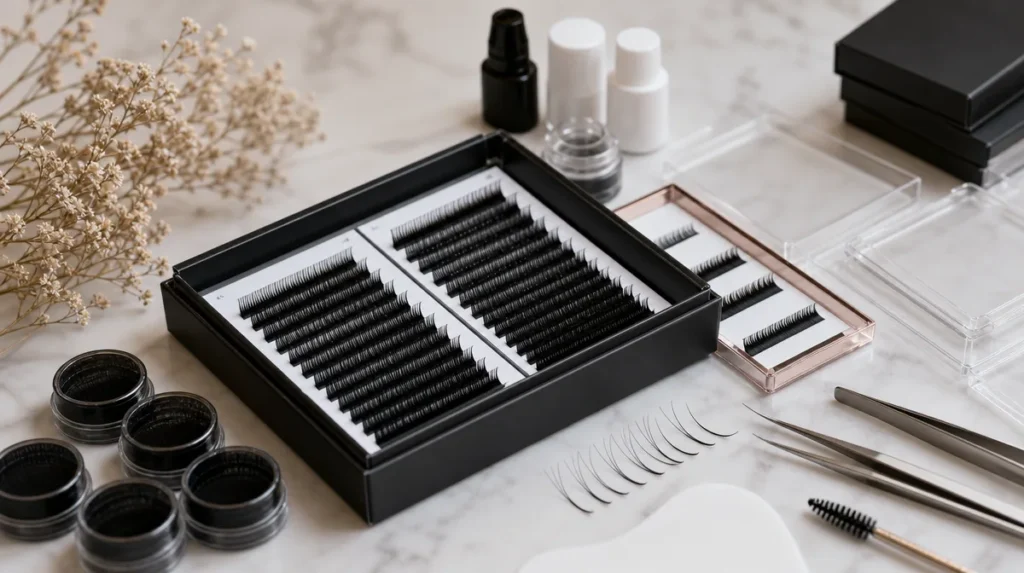
The different types of lash extensions matter most when a catalog needs to help buyers choose by fiber, finish, base design, and application method. In wholesale, variety only works when each lash type is described with clear product facts that technicians can compare quickly.
For brands and distributors, consistency matters as much as choice. Lashfine positions itself as a lash business partner and frames its work around eyelash extension products, private labeling, and customer care, which matches what salon buyers usually need from a supplier. This guide organizes the main types of lash extensions by material and shape so suppliers can build a more usable wholesale assortment.
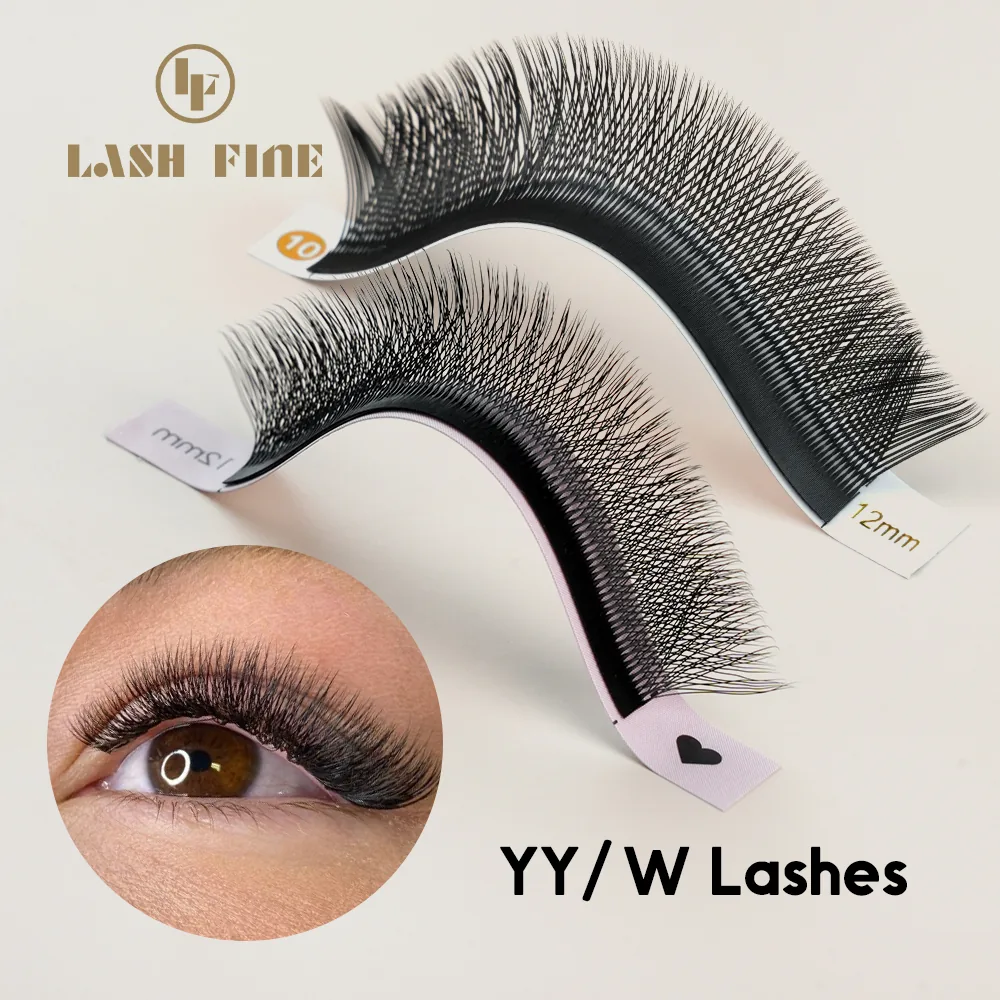
The focus is on practical product distinctions: matte versus high-shine finishes, Korean PBT fiber construction, lash diameter, curled profiles, and structured bases that help artists work faster and more consistently.
I. The core material range: 9 individual lash styles
A lash catalog usually starts with individual lashes, but individual lashes are not one uniform product. Different fibers and finishes create different application results, from a glossy, dramatic look to a softer, more natural appearance. A supplier assortment may include multiple finishes so technicians can choose by client preference and service style.
Brands that work closely with beauty professionals often refine these details through ongoing product development. Lashfine states that it combines years of industry experience in the lash scene with customer feedback to develop products according to expert opinions and user requirements. That kind of product-development loop matters in wholesale, where slight differences in finish, taper, or fiber feel can affect technician satisfaction.
For example, a silk-style lash is typically chosen for a brighter, more reflective effect, while a cashmere-style lash is usually selected for a softer, lighter-feeling finish. In wholesale terms, the important distinction is not the marketing language but the product behavior: shine level, softness, taper, and how the lash handles pickup and placement.
A. Faux Mink Pro
Faux Mink Pro is positioned as a premium individual lash option within the line. Its defining product traits are a semi-matte finish, a deep black appearance, and a tapered tip. The fiber is described as Korean PBT, a synthetic fiber commonly used in professional lash extensions because it can be formed into consistent curls and fine tapers.
For suppliers, the practical selling points are measurable: the lash is designed to reduce the blue or grey cast sometimes seen in lower-grade black fibers, while keeping a base that supports pickup and placement. That makes it suitable for salons that want a darker finish without a high-gloss synthetic look.
B. Premium Matte
Premium Matte is the no-reflection option in the individual lash range. The main product characteristic is the matte surface, which reduces shine under bright lighting and in photography. That makes it useful inventory for artists who want a more natural visual result or for clients who dislike a plastic-like reflection.
From a catalog standpoint, the value of a matte lash is easy to explain: it gives technicians a lower-gloss option that still fits standard lash application workflows. The key product facts to highlight are finish, fiber consistency, and how the lash compares to silk or glossy black fibers.
C. Super Silk
Super Silk is the higher-shine style in the individual lash family. In practical terms, it is the option for a stronger black visual effect and a more polished, noticeable finish. Suppliers often use this type of lash for customers who want definition and a more dramatic appearance.
The material claim that matters most here is the finish, not the adjective. A silk-style lash should be described by its visual reflectivity, the consistency of the synthetic fiber, and the intended wear style.
D. Cashmere Mink
Cashmere Mink is presented as the softer-feeling, lightweight option. The main product idea is a plush touch and a less reflective surface. That makes it relevant to salons serving clients who want a softer lash line rather than a bold high-shine finish.
For wholesale buyers, the key facts are softness, weight perception, and finish. If a lash is marketed as cashmere-like, the practical expectation is a more subdued appearance and a comfortable wear profile.
E. Other individual lash variants
A complete supplier catalog may also include additional individual lash variations by curl, diameter, and length. In practice, the most useful standards are:
- Diameter: commonly selected to control weight and fan size
- Curl: used to shape the final lift and visual openness
- Length: used to balance fullness with the client’s natural lash health
- Finish: matte, semi-matte, or glossy
- Fiber type: synthetic PBT-based lash fiber is commonly used in professional extensions
These are the terms technicians and buyers use when comparing products across suppliers. They are also the most useful fields for product pages, training sheets, and wholesale order forms.
F. Source and quality signals for material claims
Because material claims matter in procurement, suppliers should state whether a lash line uses synthetic PBT fiber and should avoid vague wording when describing finish or performance. If a catalog says a lash is semi-matte, glossy, or matte, that description should remain consistent across the product page, carton labeling, and training documents.
For sourcing quality, buyers commonly look for:
- Fiber consistency across lots
- Curl stability after packaging and storage
- Clear diameter and length labeling
- A defined finish category, such as matte or semi-matte
- Batch or lot traceability in professional supply chains
These are practical manufacturing and sourcing signals, and they are especially useful for salon distributors, educators, and procurement teams evaluating repeat orders.
II. High-performance attachment design: Laser Lashes
Laser Lashes are presented as a retention-focused product in the assortment. The distinguishing feature is the base texture: 360-degree microscopic indentations near the base that are intended to create more surface contact for adhesive bonding. The product claim here is about geometry, not branding.
For suppliers such as Lashfine that serve professional buyers, this kind of detail matters because salon customers often compare products by application behavior rather than by name alone. The lash is designed so the adhesive can grip a textured base more securely than a smooth one. For factual accuracy, retention should be described as a design intent rather than an absolute guarantee.
The texture is meant to support adhesive contact and placement consistency, especially when retention is a priority. The relevant performance claim is tied to the textured base design rather than a promise of specific wear time. Suppliers should connect any retention language to the adhesive system, application method, and room conditions used by the technician.
Lash extension wear is affected by the natural lash cycle, cleansing habits, adhesive choice, and application precision. This type of lash is especially relevant for clients with oily natural lashes or for artists who want a more secure-looking bond at the attachment point. The practical application note is that the lash should still be used with an appropriate professional adhesive and standard isolation, pickup, and placement technique.
For suppliers, Laser Lashes belong in the same conversation as adhesive viscosity, humidity range, and base contact area. Those are the terms buyers expect when evaluating performance-oriented lashes.
A. Application context for retention-focused lashes
A lash designed with micro-texturing should be positioned as one part of a full retention system. In professional use, the technician still needs:
- A lash adhesive matched to the room environment
- Correct humidity control
- Clean natural lashes before application
- Adequate bonding surface at the base
- Proper isolation and placement
This is why retention-related product claims should be framed with evidence language: the base design is intended to increase adhesive contact, but the final result depends on the full service process.
B. Supplier vocabulary for performance lashes
When comparing performance lashes, buyers commonly ask about:
- Base texture
- Adhesive compatibility
- Pickup behavior
- Curl retention
- Fit for oily lashes
- Suitability for classic, hybrid, or volume sets
Including these terms in product pages improves catalog usefulness and helps technicians understand where the product fits in their service menu.
III. Geometry that saves time: U-shape, W, and YY lashes
Alphabet lashes are a major category in modern lash supply because they reduce application time and simplify the creation of volume effects. These lashes are useful in salons that want a fuller finish without hand-making every fan.
A. U-shaped lashes
U-shaped lashes are designed with a flat bonding base and a soft branching profile. The value of this shape is that it sits flush against the natural lash while still creating a fuller visual result than a single standard extension. This makes U-shaped lashes useful for sparse lash lines and for technicians who want a balanced result with less manual fan construction.
The product facts that matter are base shape, strand arrangement, and the way the lash sits on the natural lash. In application terms, U-shaped lashes are generally described as a speed-assist geometry for artists who want to reduce styling time without moving fully away from standard lash mapping.
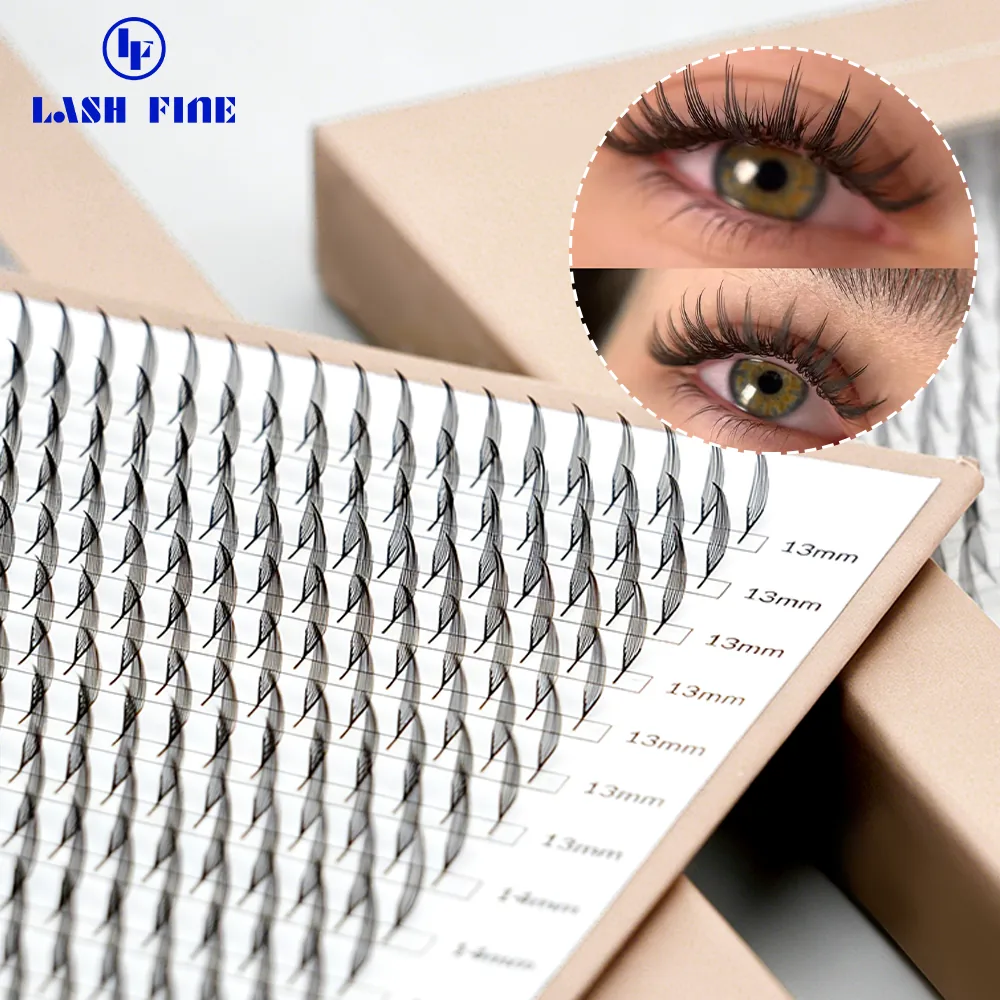
B. W lashes
W lashes are made from three bonded strands arranged in a W-like form. Their purpose is to create an instant 3D-style appearance while keeping the application process closer to classic placement than hand-made volume fan building.
For a supplier, the most useful way to describe W lashes is by structure and time-saving function. They provide a fuller look, are positioned for faster service, and are useful for technicians who want to increase visual density without changing their core application method.
In a product comparison, buyers may evaluate W lashes alongside pre-made fans, promade fans, and other shortcut volume options.
C. YY lashes
YY lashes are built with a split or criss-cross style that creates more texture than a standard single-strand classic lash. They are often used to add softness and dimension while still keeping application relatively straightforward.
The important product distinction is that YY lashes create a denser visual effect without requiring a traditional volume fan. That makes them suitable for hybrid sets, wispy mapping, and clients who want a textured finish with moderate time savings.
D. U, W, and YY lashes in supplier terms
For wholesale catalogs, these shapes are best organized by application method:
- Classic-compatible structured lashes
- Volume-style shortcut lashes
- Hybrid texture lashes
- Time-saving alternatives to hand-made fans
This makes it easier for buyers to match inventory to the services they actually sell.
IV. Product specifications suppliers should standardize
To improve catalog quality, each lash type should be described with the same core technical fields. Those fields help technicians compare different types of lash extensions across suppliers and reduce ambiguity in wholesale listings.
A useful product specification set includes:
- Fiber type, such as synthetic PBT
- Finish, such as matte, semi-matte, or glossy
- Diameter, which affects weight and fan size
- Curl, which affects lift and eye-opening effect
- Length range, which affects styling flexibility
- Base structure, such as standard, flat, or textured
- Intended method, such as classic, volume, hybrid, or time-saving placement
In addition to these fields, suppliers often improve decision-making by listing adhesive compatibility guidance. Common professional adhesive categories include fast-dry, medium-dry, and low-fume formulas, with selection influenced by humidity, technician speed, and room conditions. That kind of application context helps buyers match lashes to the adhesives they already use.
This structure reflects how lash artists actually shop. They rarely ask only for a product name; they ask what curl it has, how dark it looks, how it behaves on pickup, and whether it is suitable for their adhesive and styling style.
A. Diameter, curl, and styling outcome
Diameter and curl are among the most important selection criteria in any lash product range. Diameter affects the perceived weight and fullness of the set, while curl controls lift, openness, and the final eye shape effect.
For wholesale buyers, the practical use of these terms is straightforward:
- Smaller diameters are generally used for lighter lash applications
- Larger diameters are generally used for stronger visual density
- Stronger curls create more lift and a more open eye effect
- Softer curls create a subtler finish
These product fields give buyers a repeatable way to compare one line against another.
B. Adhesive categories commonly compared by professionals
In the lash industry, adhesive choice is usually discussed by drying speed and working conditions. Common professional categories include fast-dry, medium-dry, and low-fume adhesives. Technicians compare these options by how they match room humidity, working pace, and placement control.
This is why product pages that mention only the lash style without application context are incomplete. The relationship between lash base, adhesive viscosity, and room conditions matters to the end result.
V. Professional sourcing and authority signals
When a supplier writes about lash extensions, the wording should reflect manufacturing and professional-use standards. That means using concrete product language rather than promotional language. A stronger supplier description identifies the fiber, finish, and geometry; explains how the lash is used; and keeps the terms consistent across product pages.
If a line is made with Korean PBT, that should be stated clearly. If a lash is semi-matte, that should be the descriptor used. If the base is textured for retention, the description should explain that the design supports adhesive contact.
This also helps buyers who work with salon training programs, lash pathways, or professional retail systems. Clear terminology makes it easier for technicians, educators, and procurement teams to evaluate inventory. It also supports sourcing transparency when suppliers follow internal quality controls such as material consistency checks, curl stability review, and packaging inspection before shipment.
A. Authority signals buyers recognize
For authority signals, buyers often look for evidence of:
- Manufacturing consistency in curl and taper
- Fiber material declarations such as PBT
- Clear labeling of diameter and length
- Professional-use packaging and batch traceability
- Alignment with salon education standards or training documentation
These are practical sourcing standards, not claims unless a company can document them. If a supplier has compliance records or documented quality procedures, those should be referenced directly and accurately in the product listing or brand profile.
B. How to frame claims safely
A safe product description should separate design intent from guaranteed outcomes. For example, a textured lash base can be described as designed to increase adhesive contact, but the supplier should not promise a specific retention duration unless that result is supported by documented testing.
That same rule applies to fiber claims. If a lash is described as Korean PBT, the claim should refer to the stated fiber source or fiber category used in manufacturing, not to performance outcomes that are not documented.
VI. How technicians choose between lash types
A useful wholesale catalog does more than list products. It helps a buyer decide which lash type fits a specific service.
1. For a natural finish
Choose matte or semi-matte individual lashes with moderate curl and a consistent taper. These are useful when the client wants definition without a glossy look.
2. For a dramatic finish
Choose higher-shine styles such as silk-like lashes. These create stronger visual contrast and are often selected for full, defined sets.
3. For speed-focused services
Choose U-shaped, W, or YY lashes. These are built to reduce styling time and support faster application.
4. For retention-focused work
Choose textured-base lashes such as Laser Lashes, and pair them with an adhesive that matches the technician’s humidity and drying-speed environment.
5. For mixed-service menus
Stock a combination of finishes, curls, and diameters so artists can build classic, hybrid, and textured sets from the same supplier line.
VII. Related terms buyers compare in the same order
To expand entity coverage and help procurement teams compare products, it helps to group related terms in the same catalog language. Common terms include:
- Lash diameters: thinner diameters for lighter weight, thicker diameters for stronger visual density
- Lash curls: used to create different lift levels and eye-shaping effects
- Classic lashes: single extension placement on one natural lash
- Volume lashes: multi-extension styling with handmade or pre-made fans
- Hybrid lashes: a blend of classic and volume styling
- Promade fans: pre-formed volume fans used to speed up application
- Adhesive viscosity: the thickness and flow behavior of lash glue
- Drying speed: how quickly the adhesive sets during placement
- Humidity range: the room conditions that affect adhesive performance
- PBT fiber: a common synthetic material used in professional extensions
These terms help suppliers present a catalog in the way lash technicians already think about product selection.
FAQ
What should a supplier list first for each lash type?
Fiber type, finish, diameter, curl, base structure, and intended application method.
Which lash types help technicians save time?
U-shaped, W, and YY lashes are commonly chosen for faster application because they simplify the creation of fuller looks.
What is the main difference between matte and high-shine lashes?
Matte lashes reduce reflection and look softer, while high-shine lashes create a stronger glossy appearance.
Why are textured bases useful?
Textured bases are designed to give adhesive more surface contact, which can support a more secure attachment at the lash base.
What does PBT mean in lash extensions?
PBT refers to a synthetic fiber commonly used in professional lash extensions because it can hold curl and taper consistently.
 English
  German
  French
  Spanish
  Romanian
  Portuguese
  Dutch
Dutch  Italian
  Swedish
  Polish