


How long lash extensions last is the question every client asks at the end of the first appointment, and the answer most technicians give – six to eight weeks – is technically true and practically useless. It describes a calendar interval, not a lifespan. A set does not expire on a date. It thins, unevenly, from the day it is applied, and the rate at which it thins is decided by three separate clocks running at once.
Understanding those three clocks changes what a client expects and what a technician can promise. It also explains the most common argument in the treatment room: two clients, same adhesive, same technique, same aftercare leaflet, and one returns at two weeks with a full set while the other returns at ten days looking sparse. That difference is not luck, and it is not usually a technique failure. It is the clocks running at different speeds.
This guide separates the three, sets out how to tell a normal shed from a bond failure, and identifies what a technician can genuinely control versus what has to be managed by expectation. It is written for the person doing the set as much as for the person wearing it.

What “Six to Eight Weeks” Actually Measures
The number is not wrong. It is answering a different question than the one being asked. Six to eight weeks is roughly how long a client can go before the set stops reading as a full set – the point at which the density has dropped far enough that the eye notices. It is a perception threshold, not a biological one.
Within that window, the individual extensions that were applied on day one are almost all gone. The set survives as a set because of infills: new extensions are bonded to lashes that have grown in since the last visit, replacing the ones that have cycled out. A lash set is therefore not a product with a lifespan. It is a rolling replacement process, and the interval between infills is what the client is really buying.
Two consequences follow. First, “how long do lash extensions last” has three defensible answers depending on which clock is being described – the natural lash, the adhesive bond, or the visual density of the set. A technician who gives one number invites the client to measure against the wrong one. Second, the practical metric is not duration but retention rate: what proportion of the extensions applied survive to the next appointment. That is measurable, comparable between clients, and improvable.
The most commonly cited infill cadence in the industry is every two to three weeks, which sits well inside the six to eight week window because density, not attachment, is what fails first. Anyone quoting eight weeks as the point at which a client can stop coming in is describing a set that has been allowed to deteriorate for several weeks.
Clock One: The Natural Lash Cycle
Every natural lash runs its own cycle, independently of its neighbours, and that cycle sets a hard ceiling on how long any single extension can stay. The growth phase, anagen, is commonly described as lasting 30 to 45 days. It is followed by a short transitional phase of roughly two weeks, and then a resting phase before the lash is shed and the follicle begins again. The whole cycle is usually quoted at around 90 to 100 days.
The practical number is the shedding rate. Because lashes are not synchronised, a small number are lost every day as a matter of course. Commonly cited figures put normal shedding at roughly two to five lashes per eye per day. Every one of those lashes takes its extension with it, and nothing applied at the base can prevent it: the extension is attached to a structure that was always going to leave.
This is why an extension applied to a lash in late anagen can be gone in a week while the identical extension on the neighbouring lash is still in place at four weeks. Both were applied correctly. The only difference is where each lash sat in its cycle on the day of the appointment. Estimates put the proportion of lashes in the resting phase at any one time in the region of 10 to 15 percent, which is enough to explain a visible gap appearing early without anything having gone wrong.
Two things follow for anyone advising a client. A sudden increase in shedding across a few days is usually a synchronised wave of lashes reaching the end of their cycle together, not a reaction to the adhesive and not a sign that the natural lashes are being damaged. And no adhesive, sealant or aftercare product changes the cycle length. Products can improve how well an extension holds to a lash; they cannot keep the lash itself in place. The relationship between lash growth and regrowth is covered separately in the guide to how long it takes for eyelashes to grow back, which is the question clients usually ask one step later.
Clock Two: The Adhesive Bond
The second clock is chemical rather than biological, and it is the one most often misdiagnosed. Lash adhesive is a cyanoacrylate, and cyanoacrylate does not dry by evaporation. It cures by reacting with moisture, which is why every adhesive has a published humidity and temperature band and why working outside that band produces unpredictable results regardless of technique.
Once cured, the bond is strong but not permanent. It degrades through three routes: oils that soften the polymer, heat and steam that stress it, and mechanical load from rubbing, sleeping face-down or picking. A bond that is degrading usually fails at the base first, because that is where the stress concentrates.
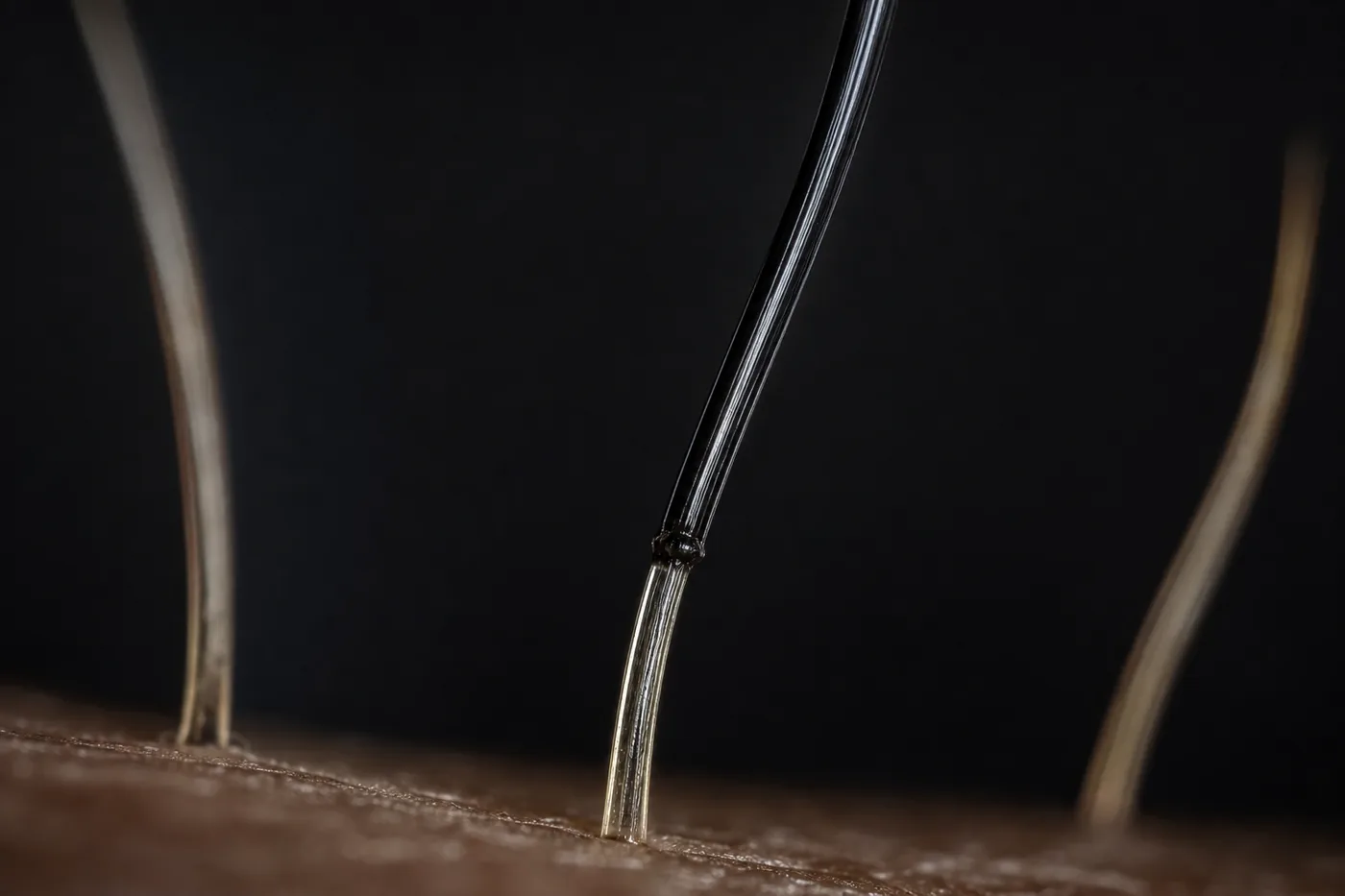
The single most useful diagnostic in lash work is the shed extension itself. An extension that comes away with a small natural lash attached, showing a clean rounded bulb at the base, was shed by the follicle on schedule. An extension that comes away alone, with a stiff little knot of cured adhesive at its base and no natural lash, failed at the bond. In the second case the natural lash is still in the client’s lid, and there will often be a bead of residue left on it.
Telling these apart matters because they point to completely different actions. Shedding is not a fault and cannot be reduced. Bond failure is a fault, and it is usually traceable to surface preparation, humidity, adhesive choice or cure time. The guide till ögonfranslim sets out how cure speed and environment interact, and the question of matching an adhesive to a specific client rather than to a house standard is covered in the note on choosing the right lash adhesive by client type and retention.
Surface preparation deserves separate emphasis because it is where most retention is won or lost before the first extension is placed. A lash carrying trace oil, makeup residue or conditioner film will accept adhesive poorly, and the failure appears days later as an unexplained pop-off. Cleansing the lash line properly at the start of the appointment, and using a dedicated primer where the adhesive system calls for one, are the cheapest retention measures available – cheaper than any adhesive upgrade. The lash primer guide covers what a primer does and, importantly, when it does nothing.
Clock Three: What the Client Does to It
The third clock is behavioural, and it is the one clients can actually influence. It is also where aftercare advice most often goes wrong, because it is frequently delivered as a list of prohibitions that clients half-remember and quietly ignore.
The behaviours that measurably shorten retention are consistent across sources: rubbing the eyes, sleeping face-down or pressing the face into a pillow, and using oil-based products on or near the lash line. Heat and steam – long hot showers, saunas, steam rooms – soften the bond and are the reason a client returning from a spa weekend reports losses. Mascara is less of a problem than the removal of mascara, since most removers are oil-based or require friction.
The behaviours that help are less intuitive. Cleaning the lashes daily with a proper lash cleanser, rather than avoiding water, reduces the oil and debris load at the base and improves retention. Clients are often told to keep lashes dry for 24 to 48 hours after application, which is correct for cure, and then to keep them dry indefinitely, which is not. A clean lash line holds better than a neglected one.
Sealants occupy a specific and limited role here. A coating product can add a small amount of protection against moisture and friction, and it is worth stocking for clients whose lifestyle is unavoidably rough on a set. It cannot repair a bond that failed at application, and it cannot slow the natural cycle. The lash sealant guide is explicit about that boundary, and it is worth being equally explicit with clients rather than letting a coating product stand in for technique.

Why Two Clients With the Same Set Get Different Weeks
Given identical work, retention varies widely, and the reasons cluster into four groups.
The first is the distribution of lash cycles on the day of application. A client whose lashes happen to be at a similar stage will lose a large share of the set in a short, dramatic window a few weeks later; a client with a spread-out distribution loses the same number gradually and reports better retention without having better retention.
The second is substrate quality – the surface of the natural lash itself. Lashes differ in porosity, and porosity governs how much adhesive a lash accepts and how evenly it cures. This is covered in detail in the note on fransporositet och bättre hållbarhet, and it explains why a change of adhesive can transform one client’s results and do nothing for another’s.
The third is hormonal and medical. Pregnancy, thyroid conditions, some medications and menopause all shift lash growth and shedding patterns, sometimes markedly. A technician is not in a position to diagnose any of this, but it is reasonable to note a pattern change and suggest the client mention it at a routine appointment rather than assume the set was at fault.
The fourth is the environment the client lives in. Dry indoor heating, high humidity, seasonal change and occupational exposure to steam or chemicals all move the third clock. Clients in the same city, treated in the same room, can have measurably different retention for reasons neither of them controls.
How to Tell Shedding From Failure
A short diagnostic sequence resolves most client complaints without guesswork, and it is worth running before any corrective action is proposed.
1. Ask to see the extensions that came away. A natural lash with a clean rounded bulb attached means normal shedding. An extension alone with a cured knot at the base means bond failure. A mix of both is the most common result and should be reported as such.
2. Check the natural lashes at the lash line. A bead of cured adhesive on a natural lash that has lost its extension confirms failure at the bond. A clean natural lash confirms a shed.
3. Look at the distribution of the gaps. Losses spread evenly across both eyes suggest a systemic cause. Losses concentrated on one side, or on the side the client sleeps on, suggest mechanical loading. Losses concentrated at the inner or outer corner suggest an application or isolation issue in that zone.
4. Compare against the previous appointment. A retention rate that has dropped sharply with no change in method points to a change in the client’s circumstances. One that has always been low points to method.
5. Time the loss pattern. Heavy loss in the first 48 hours is almost always cure or preparation related. Heavy loss at three to four weeks is almost always the natural cycle and is not a fault.
What a Technician Can Actually Control
The honest scope of control is narrower than most retention advice implies, but it covers the highest-leverage variables.
Preparation is first, and it is free. Cleansing, drying, and priming where the system requires it determine how much of the adhesive’s potential strength is actually achieved. Adhesive selection is second: a fast-curing adhesive in a hot, humid room will flash before placement, and a slow one in a cold, dry room will not cure in time. Matching the adhesive to the room and the client is more useful than standardising on one bottle. The classic lash extensions guide and the material on volymknippen both cover how fibre weight and diameter affect what the natural lash is asked to carry, which is a retention question as much as a styling one.
Isolation is third. Two natural lashes bonded together will eventually be pulled apart by normal movement, taking both extensions with them, and the client experiences this as unexplained loss rather than as a technique error. Weight and length are fourth: an extension that exceeds what the lash can support will rotate, lift or shed early, and the temptation to go heavier for a fuller look is one of the most common causes of poor retention in volume work.
What cannot be controlled is the cycle itself, the client’s hormones, the weather and whether the client sleeps face-down. Naming that boundary clearly is more useful than implying that better products would solve it, and it protects the technician from being held responsible for biology.
Vanliga frågor
How long does a full set of lash extensions last? As a visual set, roughly six to eight weeks with infills every two to three weeks. As individual extensions, far less: most of the extensions applied on day one will have cycled out well before eight weeks, replaced by new growth at each infill.
How often should I get infills? The most commonly recommended cadence is every two to three weeks. Clients who leave it longer are not extending the life of the set, they are wearing a thinning one.
Do lash extensions damage natural lashes? The cycle itself is not affected by extensions. Damage is associated with over-weighting, poor isolation and picking, all of which are application and behaviour issues rather than an inherent property of extensions. A lash that sheds with an extension attached regrows on its normal schedule.
Can I make my extensions last longer? Within limits. Cleaning them daily, avoiding oil-based products near the lash line, not rubbing the eyes and not sleeping face-down all help. Nothing extends the life of the lash the extension is bonded to.
Do extensions last longer in winter? There is no reliable seasonal rule that applies to everyone. Indoor heating and drier air affect some clients, humidity affects others, and individual shedding patterns usually matter more than the season.
The Short Version
The number a client wants is a single figure, and the honest answer is a structure: the natural lash sets the ceiling, the adhesive bond decides how much of that ceiling is reached, and the client’s habits decide how much is lost along the way. A technician who can explain those three separately can set realistic expectations on day one and diagnose a retention complaint in five minutes rather than guessing at products.
For anyone building a service around this, the useful discipline is to record retention rather than to promise duration. Counting what survived to the next infill turns a subjective complaint into a number, and a number is the only thing that can be improved. The wider question of how to build and price a service around that data is covered in the guide on preparing a lash business for the year ahead, and technicians moving from practice into paid work will find the transition covered in hur man blir fransstylist.


 English
 German
 French
 Spanish
 Romanian
 Portuguese
 Dutch
 Italian
 Swedish
 Polish