

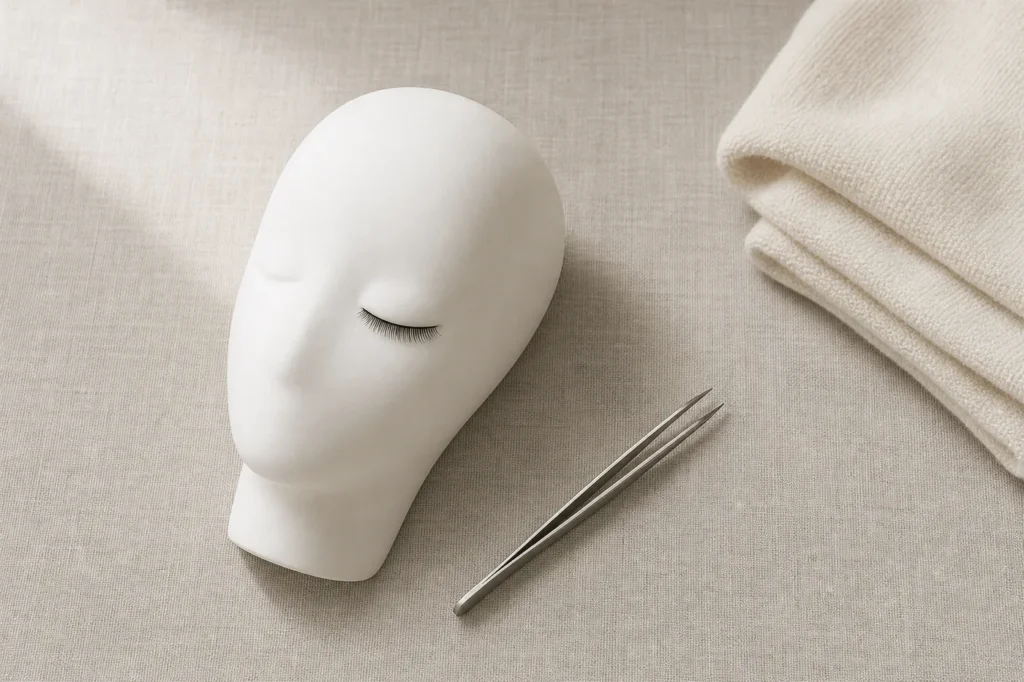
Practice lashes and a training head are the two items that decide whether a new lash technician arrives at a real client with any control at all. Nobody learns isolation, mapping or placement speed on a paying client, and no salon wants to be the place where the learning happens. The practice setup exists to absorb that learning curve somewhere harmless, and it is also one of the few parts of a lash kit that is bought once and then used for years.
For a supplier, this is the entry point of the whole catalogue. Students and newly qualified technicians buy a head, a set of strips and a pair of tweezers long before they buy adhesive by the case, and the supplier who owns that first order tends to own the account afterwards. This guide covers what a training head needs to be worth using, what practice lashes actually are, how to structure a practice routine that builds speed, what to check before paying for a course, and the small tools that keep the station usable.
Why Practising on a Head Beats Practising on People
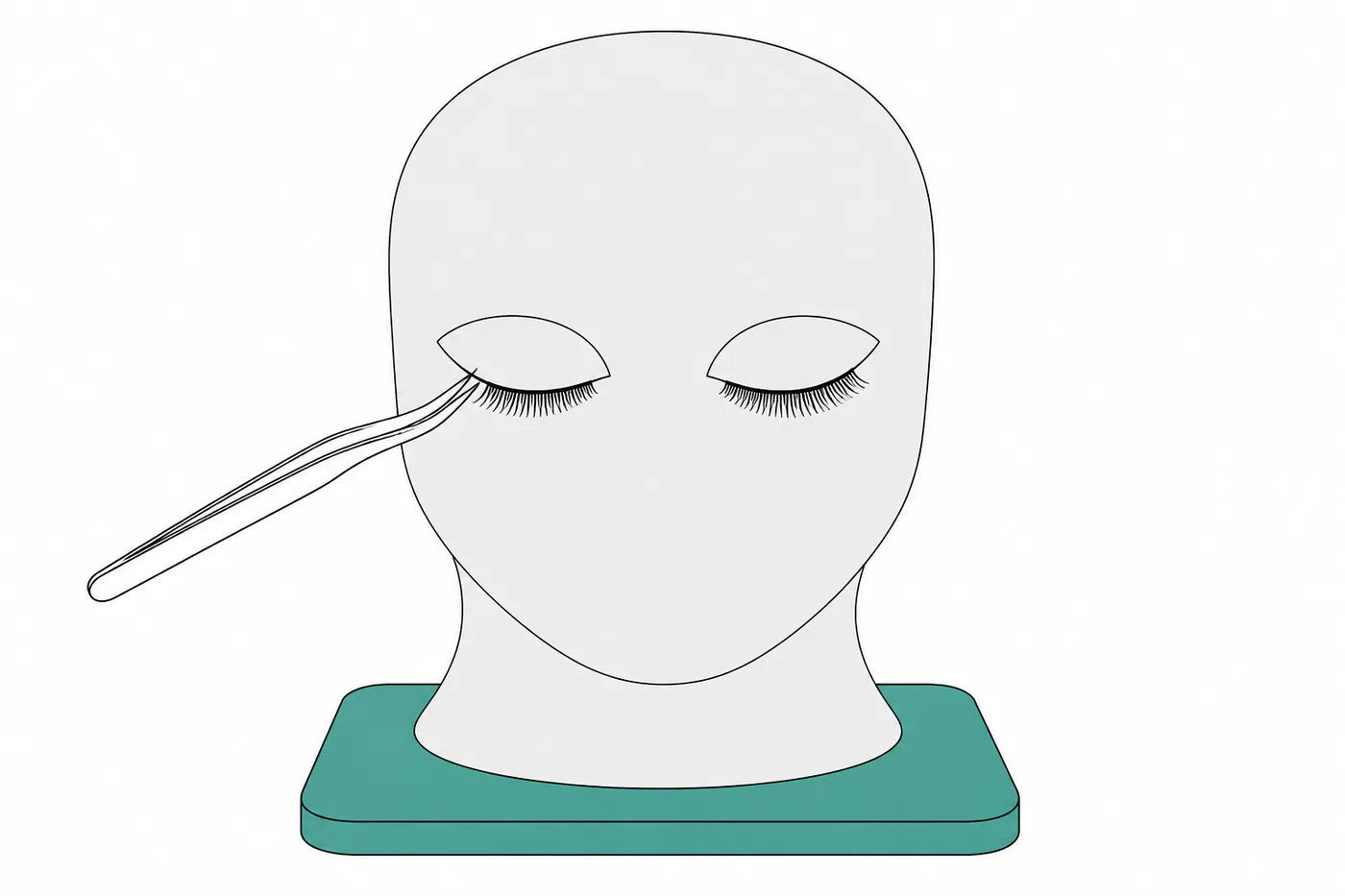
The argument for a training head is not that it feels like a client. It is that it removes the two things that make early practice useless: consequence and movement. A mistake on a mannequin costs nothing and can be repeated immediately, and the head does not flinch, blink, talk or shift its chin halfway through an isolation.
That second point matters more than most beginners expect. A live model moves, and every movement destroys the isolation the technician has just spent ninety seconds building. Practising on something that stays still lets the fundamental movements be repeated until they become automatic, which is the only way speed is ever achieved. Speed is not a matter of working faster; it is a matter of not having to think about each step.
The third benefit is that a head can be used for the parts of the service that a client will not tolerate repeatedly. Mapping the same eye five different ways, pulling a fan apart and re-making it, or timing isolation across both eyes can all be drilled on a head in an evening. On a client, none of it is possible.
Where a head stops being useful is realism of surface behaviour. Adhesive cures slightly differently on a practice strip than on a natural lash, and the tension of a real lash against a real lid is not reproducible. A technician who has only ever worked on a head will still need supervised live practice. The head builds control; it does not build judgement about a real lash.
What a Training Head Actually Needs
Three features separate a head that gets used from one that sits in a cupboard, and a buyer can check all three before ordering.
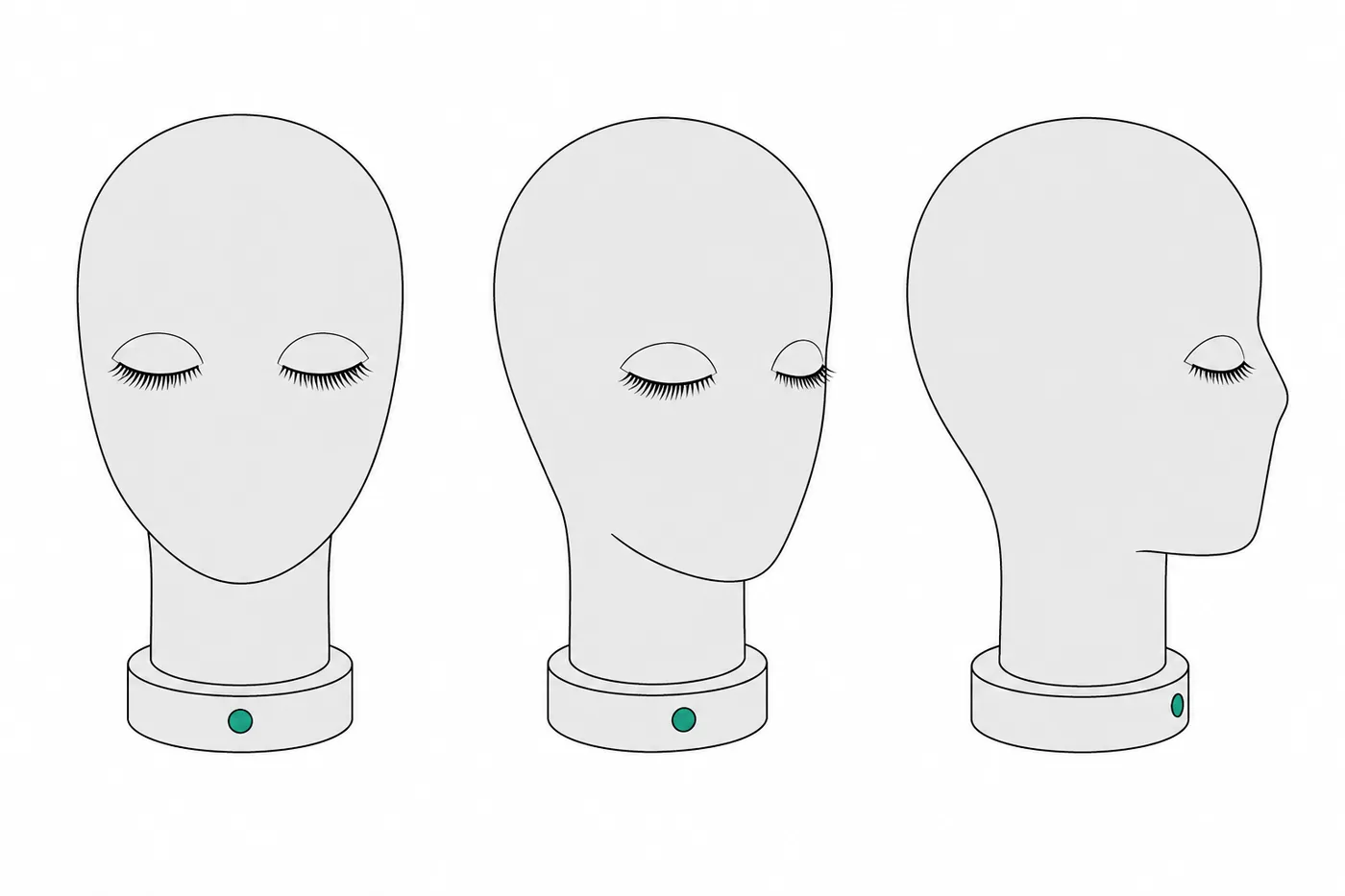
1. A weighted base and a flat back. This is the single most important specification. The head has to stay exactly where it is put while both hands are occupied with tweezers, and a light head that slides turns every practice session into a wrestling match. Look for a base heavy enough that the head can be tipped forward for a brow view and still hold position.
2. Replaceable practice lashes. The head itself should outlast hundreds of sessions, while the lash strip is a consumable. A head that accepts replacement strips is a head that is still in use a year later, and the strips are where the ongoing cost sits, which is also why the strips are sold separately.
3. Access from every angle. Mapping and placement both need a clear line of sight at the inner corner, the outer corner and across the brow line. A head that only presents a frontal view cannot be used to practise the angles that cause the most trouble on a real client.
Surface behaviour is the fourth consideration and the hardest to judge from a photograph. The lash strip should mimic the flexion and the grip of a natural lash closely enough that a fan holds its shape and a placement can be judged. The replaceable training head et le mannequin lash training head both describe this simulation as their main specification, and it is worth asking a supplier for a sample strip rather than relying on the description.
A flat-back head with a stabilised base, such as the tête d'entraînement à coups de fouet, covers the same ground at a lower specification, and it is the version most often bought by a technician practising at home between shifts, where the priority is simply that the head stays in one place on a kitchen table.
Practice Lashes: What They Are and What to Check
Practice lashes are the consumable part of the setup: a strip or a row of synthetic lashes mounted so that extensions can be applied and then removed, repeatedly, without destroying the surface. They are sometimes sold as self-adhesive strips that press onto the head, and sometimes supplied with a reusable base that the strips attach to.
Four specifications decide whether a strip is usable.
1. Adhesion to the base. A strip that lifts at the corner mid-set makes practice pointless. It should sit flat against the head or the base, with no curling at the inner or outer end.
2. Removal without damage. Practice material has to come off and go back on many times. A strip that tears or sheds fibres after two removals turns every session into a reordering exercise.
3. Realistic resistance. The lash should flex like a natural lash so that isolation and placement technique transfer. Too stiff and the tweezers behave differently; too soft and the fan collapses.
4. Row density and curl. A row that matches the curl and density of the extensions being practised makes mapping drills meaningful rather than abstract.
Where practice lashes win over any other training surface is in repetition. A technician can map the same eye thirty times in one evening on a strip, and each repetition is where the muscle memory comes from. Where they fail is in feedback: a strip will not tell a technician that a placement was too close to the lid margin, and that judgement has to come from a trainer or from supervised live work.
A note on hygiene belongs here too. A head and its strips should be cleaned between sessions, and the tools used on them should be cleaned as well, which is what the nettoyant pour pinces is for. Adhesive residue on a tweezer tip is the most common reason a beginner’s placements become unpredictable, and it is the cheapest problem in the whole routine to fix.
A Practice Routine That Actually Builds Skill
Practising without a structure produces hours of activity and very little improvement. Four drills in rotation cover the ground.
1. Mapping drills. Draw the map, then physically place strips of lashes along it. Repeat with a different map on the same eye, and then with the same map from the opposite side, which is where left-hand control develops.
2. Isolation drills. Separate one natural lash from its neighbours, hold it, and let go. Time the drill, then time it again. Isolation speed is the single biggest determinant of how long a first set takes.
3. Fan-making drills. Make, place, remove and remake. This is the drill that benefits most from a strip that tolerates repeated removal.
4. Full-set timing. Once the individual movements are automatic, run a complete set against a clock on the head. The purpose is not speed for its own sake but to establish a baseline that can be compared a week later.
Two habits make the routine work. First, keep the practice setup assembled rather than packing it away, because a head that has to be found and prepared never gets used. Second, keep a written log of times and problems, because improvement in this craft is slow enough that it is invisible without a record.
The reference material for the technique itself is worth keeping beside the head. The fox eyelash mapping guide sets out how a map translates into placement decisions, and the note on lash porosity explains why the same technique behaves differently on different lashes, which is exactly the judgement a head cannot teach.
Course or Self-Taught: What a Course Should Cover
Training courses account for a large share of the search interest in this category, and the honest position is that a course and a practice head solve different halves of the same problem.
A course supplies three things that a head cannot: a trained eye watching technique and correcting it, supervised work near a real client, and an introduction to the business side, including insurance, pricing, consent and aftercare advice. What a course does not supply is repetition. Most courses compress the practical element into a short window, and a graduate who has not practised independently arrives at a first client with the knowledge but none of the automatic movements.
That is why the two should be planned together. Before paying for training, a prospective student should ask four questions: how much of the course is supervised practical work on a live or simulated model, what ratio of students to trainer applies in the practical sessions, whether the certificate is recognised by the insurers the student intends to use, and what the student is expected to bring. The last question is where a practice kit becomes part of the course cost, and it is worth clarifying whether the head and strips are included or bought separately.
For a supplier, this is the moment the catalogue enters the conversation, and it is also why the training items are worth listing together with the adhesive rather than in a separate category. A student who buys a head and strips before a course arrives at the course already able to isolate a lash, and finishes it further ahead than a student who starts from zero.
The Kit Around the Head
Three small items complete a practice setup, and none of them are optional in practice.
A nettoyant pour pinces keeps the tips free of adhesive residue. A tip with a film of cured adhesive on it grabs unevenly, and a beginner has no way to know whether a bad placement is technique or a dirty tool. The nettoyant pour pinces is formulated for exactly that residue and is one of the cheapest ways to make practice sessions productive.
Glue wipes handle the excess adhesive that accumulates at the base and along the strip during repeated drills. The lingettes de colle pour l'extension des cils are the consumable that keeps a practice strip usable for more sessions, and they double as the item a technician reaches for during a real set.
Tweezers are the tool the whole routine depends on, and the choice is covered in detail in the guide d'achat des pinces à cils. For practice specifically, the useful advice is to drill with the tweezer type the technician intends to work with rather than a generic pair, because the tip geometry is what the muscle memory is being built around. Adhesive behaviour on a practice strip also differs from work on a client, a point the guide de colle à cils sets out in the context of cure and humidity.
FAQ
How many practice lashes will I get through? Strips are consumables and the number depends entirely on how many removals each strip tolerates. Buy a small quantity first, test how they behave after repeated application, and only then order in bulk.
Can I learn lash extensions entirely on a head? No. A head builds the movements; it cannot teach judgement about a real lash, a real lid or a real client’s comfort. Supervised live practice is still required before paid work.
Is a training head worth it if I am already qualified? Yes, for specific drills. Mapping variations, fan-making and timing can all be improved on a head without using a client’s time, which is why experienced technicians keep one.
Do I need a course to buy these items? No. The practice kit is a supply purchase, not a certification, and it is available to students and qualified technicians alike.

Where It Fits in the Range
Les tête d'entraînement au cil and its replaceable version sit at the front of a lash catalogue rather than the back, because they are what a technician buys before anything else. That gives a supplier two things: an entry order that is small and easy to win, and a natural reason to stay in contact with a customer who is about to buy adhesive, tweezers and consumables on a monthly basis.
Two things make that work in practice. List the head together with the strips and the cleaner rather than in a separate tools category, so a first order is complete and usable on arrival. And be specific about the consumable that follows: a student who understands that strips, wipes and cleaner are repeat purchases plans for them, while a student who does not will assume the head is the whole purchase and be surprised the second week.


 English
 German
 French
 Spanish
 Romanian
 Portuguese
 Dutch
 Italian
 Swedish
 Polish