

Search for lash extensions for men in the US and the top results are a 2023 Singapore salon page, a 2011 forum thread, a YouTube tutorial, a lift-and-tint post that is not about extensions at all, and one supplier blog. None of them tells a technician how to actually specify a set for a male client. Most of them repeat a version of the same vague instruction: keep it subtle.
“Subtle” is not a specification. It cannot be cut, weighed or checked before the client leaves, and it leaves the technician improvising on the day. The useful version of the question is narrower: what about the brief changes when the client is a man, and what stays exactly the same? The answer is that the technique does not change at all, and almost everything that goes wrong comes from technicians changing it.
The Assumption Worth Dropping
The reflex is to assume a male client’s lashes are shorter and sparser, and to downsize everything accordingly. The evidence does not support the assumption.
A study of eyelash status across ethnic groups in Nigeria reported that males had longer upper eyelid eyelashes than females in all three regions examined. Lash morphology – length, diameter, pigmentation and growth rate – is documented in the literature as varying enormously between individuals and populations, as a review of eyelash follicle features in the Journal of Optometry sets out. Sex is a weak predictor of what a given lash can carry.
That matters practically because the downsize reflex produces a specific failure: extensions shorter than the client’s own lashes, which do nothing visible and leave the client convinced the treatment does not work. The starting point is the individual lash in front of you, measured the same way for every client.
What Actually Changes: The Brief
What changes is not the technique but the target. Most female clients arrive with a reference image; most male clients arrive with a sentence, usually some version of “I don’t want it to look like I’ve had anything done”.
That sentence is testable. Interpreted precisely, it means three things:
Invisible at conversational distance. The set should not be identifiable from across a table. This is a density and length constraint, not a curl constraint.
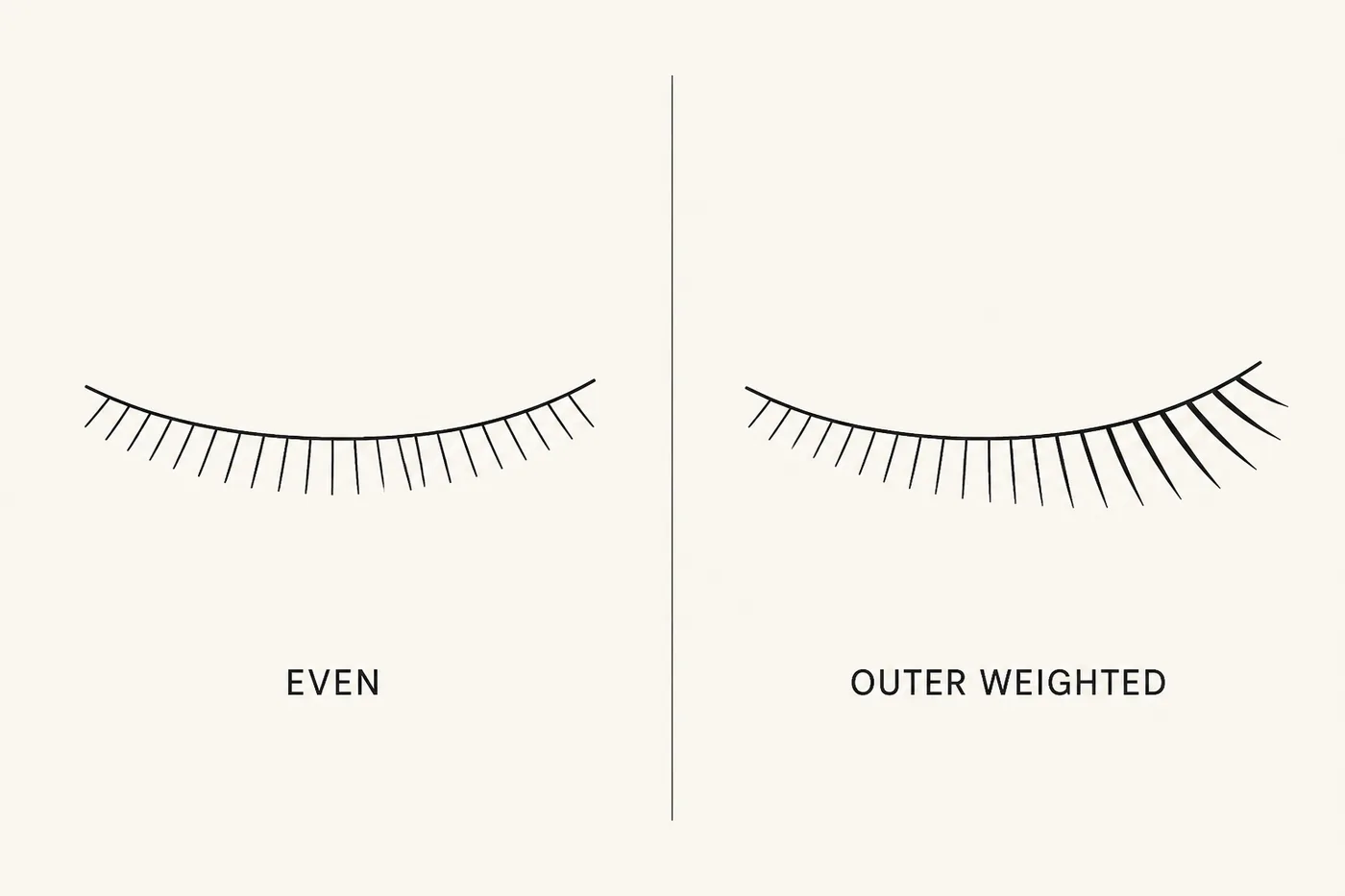
No directional styling. Cat-eye, squirrel, doll and fox mappings all read as a deliberate design. A male client asking for “nothing obvious” is asking for an even map.
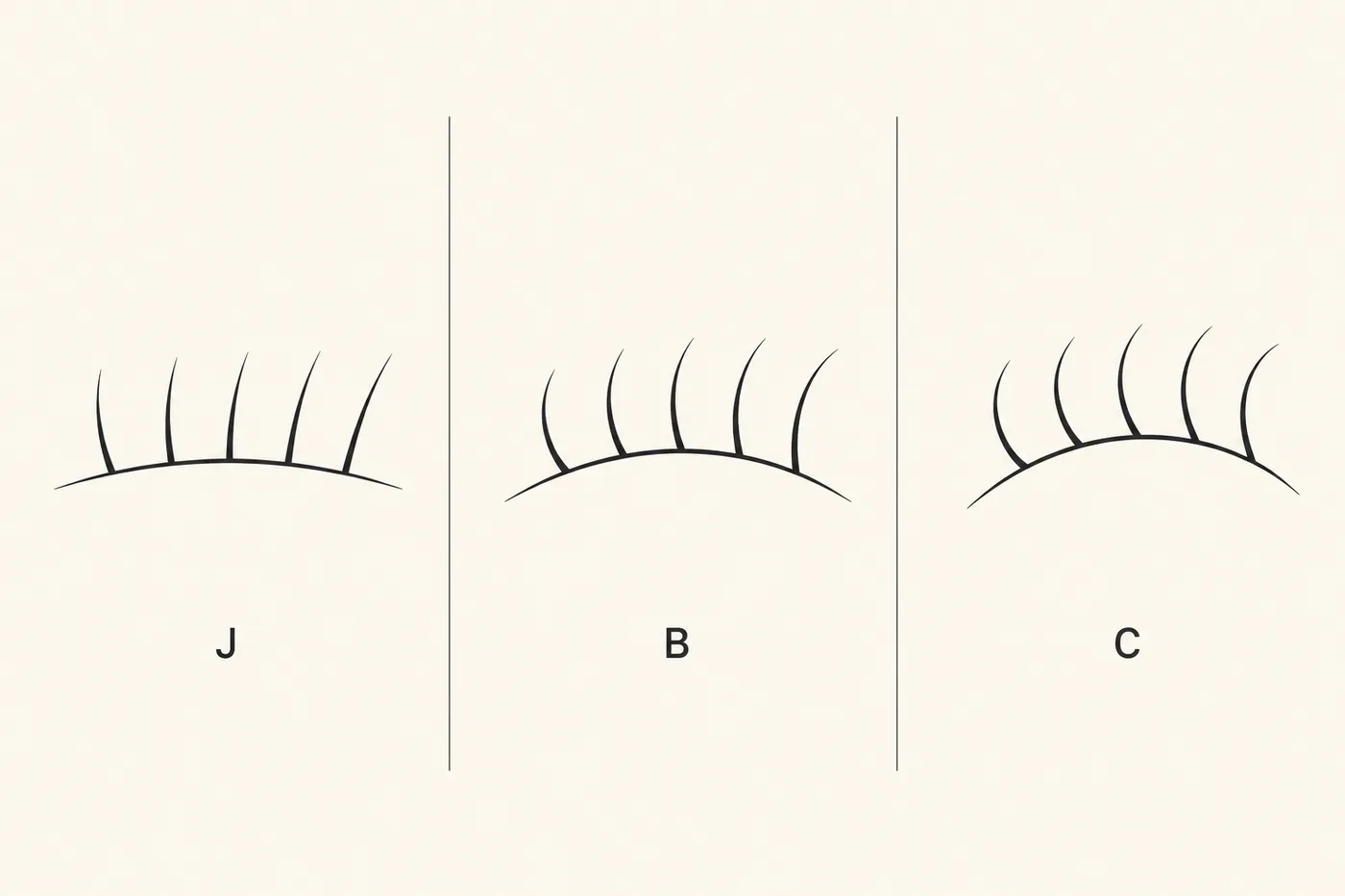
No visible curl change in profile. A high curl is the single most legible signal that lashes are not natural, because it changes the silhouette rather than the density.
The brief, in other words, is about restraint in three measurable dimensions. Once it is written down that way, the technician can choose specifications deliberately instead of guessing what subtle means.
Specifying a Set for a Male Client
The parameters that follow from that brief are conventional, not special.
Curl. J or B for most clients, C at the outside. Higher curls fight the brief in profile. If the natural lashes point downward, a flat-base curl solves the direction problem without adding visible curl, as covered in the guide to J curl lashes and the wider lash curl chart.
Diameter. Classic single extensions in the 0.10 to 0.15 range, chosen against the natural lash’s own thickness rather than against the client’s sex. A heavier fibre on a fine lash reads as a set immediately; a matched fibre does not.
Length. Within roughly the client’s natural length, plus one to two millimetres at most. Length beyond that is what produces the “you’ve had your lashes done” reaction, whatever the curl.
Mapping. Even distribution, following the natural lash line rather than an eye-shape trend. No elongation at the outer corner, no spikes.
Finish. If a matte fibre is requested, understand what is being sold: matte describes the surface treatment of the fibre, not a guarantee of invisibility. A gloss fibre applied at low density is less visible than a matte fibre applied heavily. The fibre choice matters less than the density and length around it.
The Failure Mode Nobody Writes About
The characteristic complaint from male clients is not “they fell out” but “they look like a set”. That outcome has three usual causes, and all three are decisions made during the appointment.
Outer-corner weight is the first. Adding length or density at the outer edge is the default habit from female styling, and it is the fastest way to make a set legible in profile.
High curl on straight natural lashes is the second. It creates a visible arc where the natural lash had none, and the eye reads the discontinuity before it reads the density.
Full-density black on a client who wanted nothing visible is the third. Density is cumulative: twenty extensions read as natural, sixty read as a set, and the difference is invisible to the technician who applied them over ninety minutes.
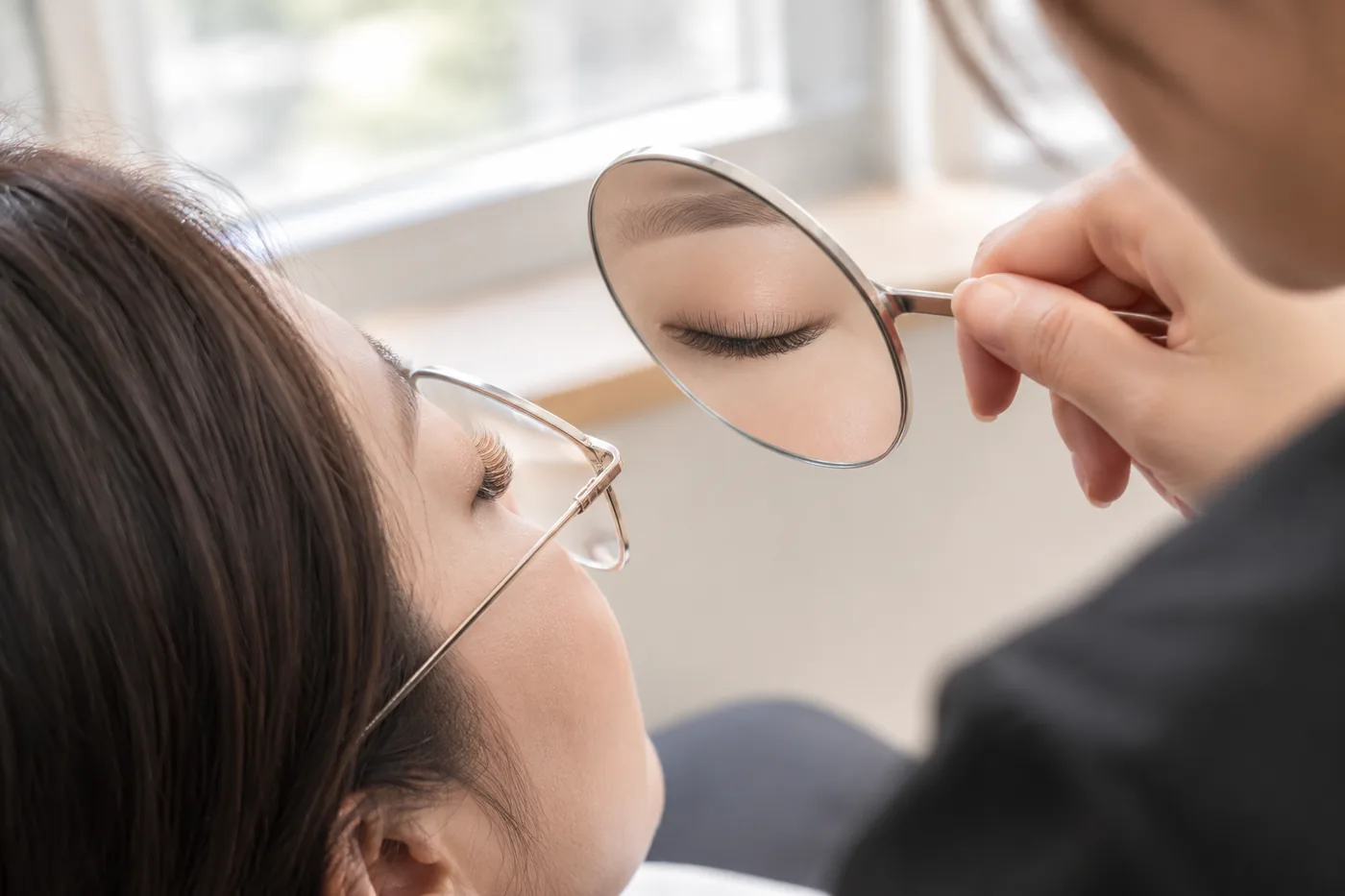
There is a check that catches all three before the client sits up: look from arm’s length, in daylight rather than ring light, and with the client’s glasses on if they wear them. Ring light flatters every set; daylight does not.
Maintenance Is the Harder Conversation
The technical work is the easy half. The harder half is the expectation, and it is where male clients most often end up dissatisfied without anything having gone wrong.
An extension set is maintained, not finished. At a two to three week refill cadence the set holds its appearance; beyond that it thins unevenly as natural lashes cycle out. That is not a defect, and the mechanics are set out in how long lash extensions last.
Clients who train, swim or play sport need that conversation before the first appointment, not after. Chlorine and heavy sweating do not dissolve a cured bond, but they do change how often a client wants to be back in the chair, and a client who expected three months of nothing will read a normal two-week thinning as failure.
The honest framing is the one that keeps clients: this is a maintenance commitment of roughly twice a month, and if that does not suit, a tint or a lift is a better answer for the same goal.
Safety, and the Part That Is Not Negotiable
Nothing about a male client changes the safety profile. The adhesive is a cyanoacrylate, and cyanoacrylates are recognised sensitisers; published case reporting documents allergic contact dermatitis from ethyl cyanoacrylate exposure (PMID 17937754). Sensitisation can build with repeated exposure rather than appearing the first time, which is why a patch test is a record rather than a formality.
The contraindications are the same as for any client: active infection or inflammation along the lash line, recent eye surgery without the surgeon’s clearance, and a known reaction to the adhesive family. Where a reaction has already occurred, the management path is set out in the guide to Allergie gegen Wimpernverlängerung, and the choice of a lower-fume adhesive is covered in Kleber für empfindliche Augen.
The one sex-specific note is practical rather than medical: clients who shave, trim or groom brows and lashes aggressively often arrive with a lash line in worse condition than their age suggests, and that is a reason to reassess load rather than to proceed as planned.
Who Should Not Get Them
Four cases where the honest answer is a different treatment.
Clients whose natural lashes point sharply downward and who reject any visible curl will not get what they want from extensions; the flat-base families solve direction but change the silhouette.
Clients who swim or train daily and cannot commit to a two-week refill cadence will spend most of the cycle unhappy.
Clients whose expectation is “put them on and forget for three months” are asking for a lift or a tint, not extensions.
Clients with existing lash damage from previous sets need the lash line to recover before load is added again; adding more is how a temporary problem becomes a permanent one.
FAQ
Do men get lash extensions? Yes. The technique is identical to any other client; what differs is the brief – typically an even map, low curl, and a length close to the natural lash so the set is not identifiable at conversational distance.
Are men’s lashes shorter than women’s? Not reliably. At least one population study found males with longer upper eyelid lashes, and lash morphology varies more between individuals than between sexes. Specify against the individual lash, not against an assumption.
How long does a men’s lash set take? A classic set typically takes around an hour to ninety minutes depending on density and the technician’s speed. Refills take less.
How often are refills needed? Every two to three weeks to maintain appearance, in line with the natural lash cycle. Stretching to four weeks is possible but the set will read thin before the appointment.
Will people notice? Only if the set is over-specified. Low curl, diameter matched to the natural lash, length within one to two millimetres, and an even map are what keep it unreadable at arm’s length.
The Short Version
The technique for a male client is the same technique as for anyone else. What changes is the brief: an even map, the lowest curl the natural lash direction allows, a diameter matched to the lash, and a length close to what the client already has.
The two mistakes are downsizing out of assumption – which produces a set that does nothing – and over-specifying out of habit, which produces the set the client specifically asked not to have. Both are avoidable by writing the brief down and checking it in daylight before the client leaves.
One disclosure: we manufacture lash extensions and adhesives, so we benefit when a set is chosen over a lift or a tint. That is why this piece spends as much space on the cases where a lift is the better answer, and on the maintenance commitment, as it does on the technique.


 English
 German
 French
 Spanish
 Romanian
 Portuguese
 Dutch
 Italian
 Swedish
 Polish